A book inside a book
The answer is the whole story, and it is a beautiful one. The point was never the words. The point was the melody. The Samaveda is what happens when a civilization decides that the sound of the sacred matters as much as its meaning — and then builds, out of that conviction, the foundations of all the music of an entire subcontinent.
Start with the fact that sounds, at first, like a scandal. The Samaveda has 1,875 verses, and all but seventy-five are taken straight from the Rigveda — something like ninety-five percent quotation. And it does not even quote evenly: it reaches overwhelmingly into just two of the Rigveda's ten books, the eighth and the ninth — the ninth being the great Soma book, entirely devoted to the sacred pressed drink. That is not a random preference. It is a fingerprint, and it tells you exactly what this text was for.
Here is the reframe that turns the scandal into wonder. The Samaveda is not trying to be a collection of poems. It is a score. The compilers went through the Rigveda the way a composer goes through a book of poetry looking for lyrics to set — selecting verses, then tearing them out of their original order and re-sequencing them not by author or by god, but by the order they would be sung in during the ritual. Trying to read the Samaveda for its words is like appreciating a song by reading only the lyrics printed in the liner notes. You are holding the right object and using it the wrong way.
So the real question is never “why borrow the words?” The words were the easy part — they already existed, perfected, in the Rigveda. The hard part, the holy part, the part worth a whole separate Veda and a whole separate priesthood, was the one thing the Rigveda did not contain: the tune.
What a sāman is
The unit of the Samaveda is not a hymn. It is a sāman — a Rigvedic verse that has been transformed into music. The very name tells you the relationship: the ancient grammarian Yāska broke it into sa + ama, roughly “that which measures out harmoniously together with a ṛc.” A ṛc is the lyric; the sāman is the lyric sung. And the transformation is drastic — the singers did things to the verse that would horrify a grammarian:
- stretchThey held a single vowel across a long, floating phrase of melody, far beyond its spoken length.
- repeatThey repeated whole words, and parts of words, for the sake of the music.
- breakThey tore words apart and rearranged the pieces.
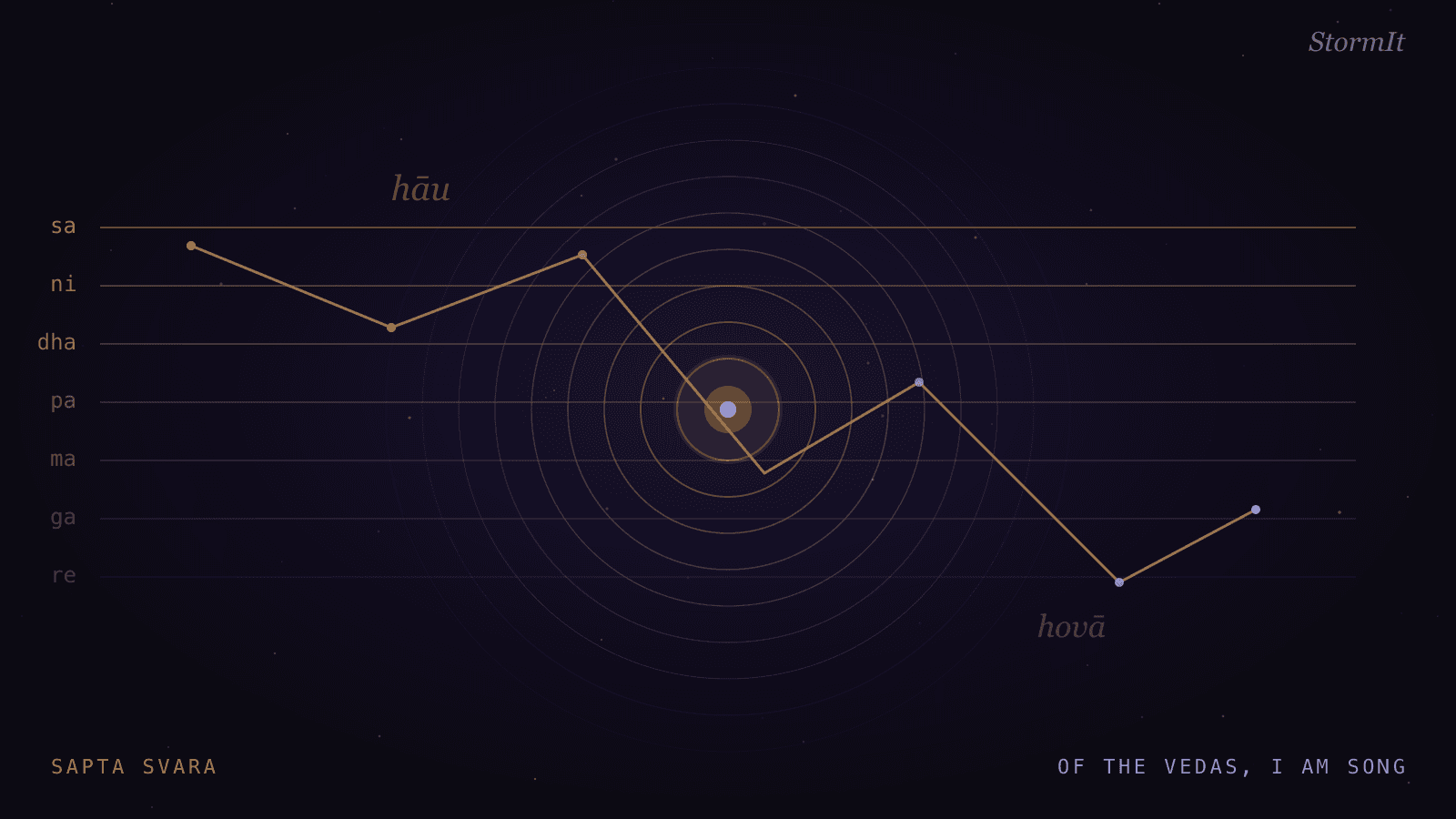
- stobhaAnd — strangest of all — they inserted sounds that mean nothing at all: hāu, hoyi, hovā, hai, oi, tāyo, sprinkled and stretched through the chant.
These meaningless inserted syllables, the stobhas, are pure music — something like wordless shouts of joy, held long on the high notes, there for no reason except the sound itself and the feeling it carries up to the gods. Think of the way a gospel song dissolves into a held “alleluia,” or a singer rides a wordless “ooh” across a melody when plain words will not carry the emotion. The Vedic singers were doing exactly that, three thousand years ago, deliberately, as scripture. The stobha is the moment the song escapes language entirely and becomes pure, soaring sound.
This is why the Samaveda needed to exist as its own text. You cannot write down a stretched syllable, a wordless cry, a melodic leap, by just copying the Rigvedic verse. The melody is additional information — and it is the information that mattered most. The Samaveda is the container built to hold what the Rigveda could not.
The words and the wordless
Open the Samaveda and it splits into two great parts, and the split is exactly the split between lyrics and music. The first part, the Ārcika, is the collection of verses — the lyrics, drawn from the Rigveda. The second part, the Gāna, is the true Samaveda: the actual melodies, the songs, the how it is sung. A melody in the Gāna corresponds to a verse in the Ārcika the way a tune corresponds to a lyric — and it has no equivalent anywhere else in the Vedic world.
- Pūrvārcika“The earlier verses,” the source-book of lyrics arranged by the gods they address — first Agni, then the great block for Indra, then the Soma verses.
- Uttarārcika“The later verses,” the same lyrics arranged instead by the sequence of the rituals.
- GrāmageyaMelodies “to be sung in the village” — the public songs, for the open ceremonies, the crowd and the firelight.
- AraṇyageyaMelodies “to be sung in the forest” — for solitary, meditative use, the songs you took away to sing alone in the silence of the trees.
A civilization that distinguished, in its sacred music, between the song for the village square and the song for the lonely forest had a very sophisticated idea of what music is for.
The priest who sang
Every Veda had its specialist priest, and the division of labor is itself revealing. The Rigveda belonged to the hotṛ, who recited the verses of invocation. The Yajurveda belonged to the adhvaryu, who muttered the formulas and did the physical work of the offering. And the Samaveda belonged to the udgātṛ — literally “the one who sings aloud,” the up-singer, from the same root as udgītha, the high song.
Picture the great Soma sacrifice, the central and most elaborate ritual of the whole Vedic world. At its climactic moments, as the Soma is pressed and offered, it is the udgātṛ and his assistants who lift their voices and sing — and they sing the sāman in named parts: the prastāva (the prelude, the leading-in), the udgītha (the high song, the central soaring portion), the pratihāra (the response), and the finale. This was not one priest droning. It was something closer to a small choir, with parts and entries and responses, performing a composed piece of sacred music at the most charged moment of the rite.
Because the udgātṛ's whole vocation was sound, the Samaveda became the keeper of musical knowledge the other Vedas never held — even an ancillary science of music, the Gāndharva Veda, of melody and rhythm and the playing of the vīṇā. The thread from the Vedic singer to the classical musician of India runs directly through these priests.
— the keepers of the song
From three notes to seven
Here is where the Samaveda's story becomes the story of music itself, and it is worth slowing down for, because almost nobody knows it. In the very beginning, Vedic chant used only three tones — the same three that governed all recitation, including the Rigveda: udātta (the raised note), anudātta (the lowered note), and svarita (the moving, combined note). Three pitches, and that was the whole palette. The oldest accompaniment, the tradition says, was a simple lyre with just three strings, one for each note.
But the sāman wanted more. Singing is hungrier than speech; a melody that soars and dips needs more than three steps to move through. And so, over time, out of those three accents, the Samaveda singers developed a scale of seven notes — and they named them in descending order, because the sāman melodies characteristically moved downward, from high to low: krushṭa, prathama, dvitīya, tṛtīya, caturtha, mandra, atisvārya. First, second, third, fourth — a counted, deliberate, seven-step scale.
This is the Samaveda's deepest claim to greatness, and it is not a mystical one but a historical one, widely accepted. The whole towering edifice of ragas and talas — of Tansen and Tyagaraja and every singer since — rests on a foundation poured by the udgātṛ priests. The civilization that decided the sound of scripture was holy ended up inventing, almost as a side effect, one of the richest musical traditions on the planet. The Rigveda gave India its words. The Samaveda gave it its song.
A thousand branches
There is a poignant footnote here, the same one that shadows all the Vedas. The grammarian Patañjali made a famous remark — sahasravartmā sāmavedaḥ, “the Samaveda has a thousand paths” — sometimes read as a thousand schools each preserving its own version of the songs, sometimes more poetically as a thousand ways the sāman can be sung. Either way, the image is of an almost unimaginable abundance of sacred music. Of that thousand, three survive.
- KauthumaThe most-followed today, chiefly in the north and west.
- RāṇāyanīyaClose kin to the Kauthuma, with its own fine differences of singing.
- JaiminīyaAlso called Talavakāra; preserved mainly in the south — Kerala, Tamil Nadu, Karnataka — and held by many to be the oldest and most musically intricate of the three.
Each school guards its own distinct way of singing — how long to hold a vowel, where to place a stobha, how many notes in the scale, the precise shape of every melodic turn — with the same fierce devotion to exactness that preserved the Rigveda. Because if the melody drifted, the sāman was no longer the sāman. The song was the scripture, and a wrong note was a kind of corruption.
That all of this was carried for three thousand years with no written notation, no recordings, nothing but the trained voice passing the melody from teacher to student, mouth to ear — that is the same miracle as the Rigveda's preservation, except harder, because melody is even more fragile than words. A misremembered word breaks a meter and announces itself; a melody can erode by a hair a generation, drifting imperceptibly. When you hear a Jaiminīya sāman sung in a Kerala village today, you are hearing, as nearly as anyone can, the actual music of the Bronze Age — not a reconstruction, not a guess, but a living melody handed down unbroken from the world of the Rigveda.
Why Krishna chose it
So return to that line from the Bhagavad Gītā, where Krishna, naming the highest thing in each category that expresses his own nature, says: of the Vedas, I am the Samaveda. Of all four, he chose the songbook. You can feel why. The Rigveda is the mind of the tradition — its words, its gods, its philosophy, its questions. But the Samaveda is its voice raised in song: the moment the words lift off the ground and become melody, the moment meaning overflows into pure sound, the moment the stobha breaks free of language altogether and becomes a wordless cry of joy held long on a high note.
There is something in music that goes where words cannot, and the Vedic tradition knew it, and built an entire scripture to honor it. To say “of the Vedas I am the Samaveda” is to say: of all the ways the sacred shows itself, the one that comes closest to me is song.
— Bhagavad Gītā 10.22
That is the Samaveda's real nature, and why a “book of borrowed words” is nothing of the kind. It borrowed the words precisely because the words were never the point. What it added — the stretched syllable, the wordless cry, the seven descending notes, the melody held in a living voice for three thousand years — was the thing the Rigveda could not hold, and the thing that became the music of a civilization. The shortest of the four Vedas, the most derivative on paper, turns out to be the one that sings. And somewhere in a village in Kerala this morning, an udgātṛ is teaching a boy to hold a single syllable across a long, falling line of melody, correcting the exact curve of his voice — and the oldest song on earth goes on being sung into one more day.

Comments