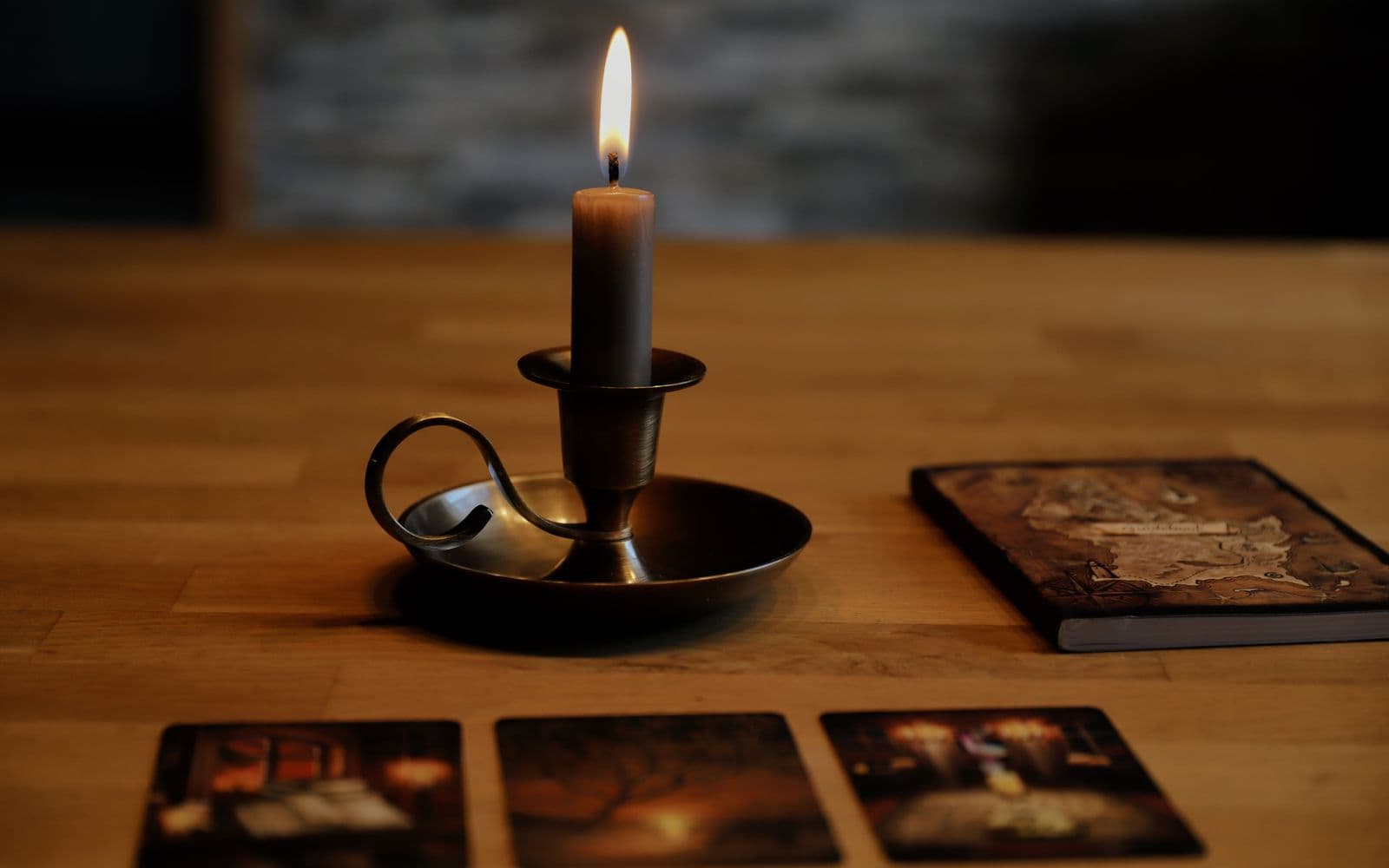
The Occult, Honestly · Part 1
Modern spirituality can feel strangely preassembled. Tarot, chakras, karma, crystals, Atlantis, past lives, hidden masters, ancient Egypt, sacred geometry, energy healing, "vibration," "ascension," "ancient wisdom," and the idea that all religions secretly point at the same truth — these ideas travel together now, as if born from one great underground tradition.
But they were not born from one place. Some came from India. Some from Buddhist and Hindu philosophical worlds. Some from Jewish mysticism. Some from Renaissance magic. Some from late-antique Greek, Egyptian, and Christian syncretism. Some from medieval and early-modern alchemy. Some from Freemasonry and Rosicrucian myth. Some from Victorian séance rooms, table-rapping, and the era's obsession with invisible forces.
So the first question is simple: who glued them together? Not perfectly. Not innocently. Not without theft, fantasy, racism, Orientalism, exaggeration, and fraud accusations. But somebody did help glue them together.
That "somebody" was not one person alone. If this story has a central storm-eye, though, it is Helena Petrovna Blavatsky — the Russian-born occultist who helped found the Theosophical Society in New York in 1875 and then built one of the most influential esoteric systems of the modern world. Before we meet her, we need to understand the room she walked into. Because the occult was not a quiet thing waiting to be discovered.
It was already boiling.
What this guide will show you
- What occult and esoteric traditions existed before Theosophy
- Why the nineteenth century was so hungry for invisible worlds
- Why fraud and exposure rarely killed occult movements
- What Blavatsky actually reorganized
- Why modern spirituality still feels Theosophical, even when it never says the word
This is not a guide to proving Theosophy true. It is a guide to understanding why Theosophy became powerful. Those are different questions — and confusing them is how people get lost in the fog machine.
The thesis in one sentence
Theosophy did not invent the occult. It reorganized scattered occult currents into a universal spiritual operating system.
Before Blavatsky, Western esotericism looked like a cabinet of curiosities: Hermetic manuscripts, Neoplatonic ladders of being, alchemical emblems, Kabbalistic diagrams, Rosicrucian manifestos, Masonic lodges, mesmerist trances, spirit rappings, and newly translated Asian scriptures sitting near one another — but not yet fused. After Blavatsky, many of those materials could be read as fragments of one hidden doctrine: a single ancient wisdom tradition, guarded by hidden adepts, encoded in every religion, recoverable through occult study.
That is why she matters. Not because every claim was true. Not because her sources were clean. Not because the movement was ethically innocent. But because she helped build a system in which everything could be made to point toward everything else.
That was Theosophy's genius. It was also part of its danger.
How to use this guide
Each of the ten sections below gives you four things: The Stream (the tradition before Theosophy), What it gave the occult (its contribution to the later esoteric imagination), Why Theosophy cared (how Blavatsky and her successors could absorb it), and an Evidence status line. Think of it as a map of the room before the séance starts.
Hermeticism: ancient wisdom with a false passport
The first object in the cabinet is Hermes — not the Greek messenger god exactly, and not the Egyptian god Thoth exactly, but the hybrid figure Hermes Trismegistus, "Thrice-Great Hermes," imagined as an ancient sage who preserved divine wisdom from the dawn of civilization.
When Greek manuscripts of the Corpus Hermeticum reached Italy from Byzantium in the fifteenth century, Marsilio Ficino translated much of them into Latin. Renaissance readers often believed Hermes was immensely ancient — in some accounts a contemporary of Moses — which made the texts look like a primordial source behind philosophy, magic, and religion. Modern scholarship places the philosophical Hermetica far later, in Egypt around the second to third centuries CE, as part of a late-antique world of Greek, Egyptian, Jewish, Christian, and philosophical syncretism.
- The idea that there is an ancient, hidden wisdom older than official religion
Here is the delicious historical twist: Hermeticism's authority depended partly on a dating error. In 1614 the scholar Isaac Casaubon argued that the Hermetic writings were not primeval Egyptian wisdom from the age of Moses, but much later works from the early Common Era. His philological work pushed the texts toward the second or third century CE, not remote antiquity.
And yet Hermeticism did not disappear. The passport was fake. The traveler kept moving.
Neoplatonism: the ladder behind the invisible world
If Hermeticism gave the occult its ancient glamour, Neoplatonism gave it architecture. Emerging in late antiquity — especially through Plotinus and later Platonists — it flourished roughly from the mid-third to mid-seventh century CE, absorbing and harmonizing much of earlier Greek philosophy, religion, and intellectual culture.
At the center is a vision of reality as layered: the One, Intellect, Soul, and the material world. Reality flows downward from unity into multiplicity, and the soul's path is a return upward toward its source. Plotinus's cosmology turns on three foundational realities — the One, Intelligence, and Soul — from whose unity all existence emanates. This is the ancestor of many later occult diagrams: higher planes, lower planes, ascent, emanations, correspondences, levels of consciousness.
The occult loves stairs. Neoplatonism built a marble staircase.
- Hierarchy and emanation
- Spiritual ascent as a path
- The idea that reality has invisible levels
Later Theosophical planes, subtle bodies, and hidden hierarchies fit easily into this kind of vertical universe.
Rosicrucianism: the hidden-brotherhood fantasy
Now enter the secret society. In the early seventeenth century, anonymous Rosicrucian manifestos announced a hidden fraternity of enlightened adepts. The three classic texts are generally identified as the Fama Fraternitatis (1614), the Confessio Fraternitatis (1615), and The Chymical Wedding of Christian Rosenkreuz (1616) — anonymous pamphlets announcing a secret brotherhood of mystics and alchemists.
The key question is not only whether such a brotherhood existed as described. It is what the story made possible: a hidden fraternity, secret initiates, ancient wisdom, a brotherhood guiding history from behind the visible world. Before Theosophy had its Mahatmas, the Western esoteric imagination already had invisible colleges.
- The fantasy of secret adepts guarding world-transforming knowledge
Blavatsky's Masters of Wisdom did not arrive in a vacuum. They stepped onto a stage already set by Rosicrucian myth, Masonic secrecy, and the older dream of hidden teachers.
Freemasonry: truth in degrees
Freemasonry matters here less as a doctrine than as a structure: lodges, degrees, initiations, symbols, ritual speech, oaths, and a sense that truth is not simply learned but unveiled.
That grammar became part of modern occultism. You do not merely read — you pass through. You are tested. You rise. You receive what the profane cannot yet understand. The same shape recurs across esoteric movements: outer circles, inner circles, grades, secrets, initiations, hidden teachers, advanced students, concealed doctrines.
- The grammar of initiation — graded revelation as something that already made cultural sense
Theosophy was not simply Masonic, but its ideas of inner and outer teaching, esoteric sections, probationary discipleship, and spiritual hierarchy all landed with readers already fluent in initiatory culture.
Kabbalah: the universe as hidden structure
Kabbalah gave Western esotericism a powerful idea: reality has a hidden architecture. In Jewish Kabbalah, the divine manifests through the sefirot — a pattern of emanations and relationships between God, cosmos, language, and soul. Christian Kabbalists later adapted these concepts into a broader Renaissance framework, often to support Christian theology, magic, and universal-wisdom projects.
By the time modern occultism inherited Kabbalah, it had become a symbolic machine for correspondences: planets, angels, letters, numbers, body parts, virtues, divine names, and cosmic levels all mapped onto one another. The universe became readable — not like a newspaper, more like a cipher.
- Correspondences and sacred language
- Emanation as a cosmic pattern
- The idea that visible reality encodes invisible order
Alchemy: matter as spiritual theatre
Alchemy is often flattened into one question: did people really try to turn lead into gold? Yes, some did. But alchemy was never only about metal. It was also about transformation — corruption into purification, death into renewal, base matter into noble substance, the ordinary self into something illuminated.
Alchemy gave the occult one of its most durable instincts: the material and spiritual worlds mirror one another. If matter can be refined, so can the soul. If hidden fire transforms metals, perhaps hidden discipline transforms the human being. The furnace is never just a furnace. The vessel is never just a vessel. The gold is never just gold.
- Transformation and purification as symbolic process
- The correspondence between material and spiritual change
Theosophy absorbed alchemical language into a broader evolutionary vision: everything develops, refines, ascends, transmutes.
Mesmerism: invisible force enters the body
Then the air changes. We are no longer in Renaissance libraries but in salons, clinics, parlors, and demonstration rooms. A physician stands before a patient and claims a subtle force moves through living bodies.
In the late eighteenth century, Franz Anton Mesmer claimed an invisible fluid — "animal magnetism" — could be manipulated to heal illness. This arrived in an age already fascinated by invisible forces: electricity, magnetism, gravity, gases. Mesmer gave invisible force a therapeutic theatre.
In 1784 a French royal commission examined animal magnetism. It included major scientific figures, among them Benjamin Franklin and Antoine Lavoisier. Later accounts emphasize that the commissioners used methods resembling single-blind and placebo-controlled testing, and concluded the effects were better explained by imagination, expectation, and suggestion than by any real magnetic fluid.
That should have ended Mesmerism. It did not. Instead it mutated — into trance, into hypnotic states, into clairvoyance, into the idea that a "sensitive" person could enter an altered condition and return with knowledge unavailable to ordinary consciousness.
The fluid failed. The trance survived.
- Altered states and invisible influence
- Suggestion and trance-knowledge
- The figure of the sensitive clairvoyant
Spiritualism: the dead become democratic
In 1848, in Hydesville, New York, two young sisters — Maggie and Kate Fox — reported mysterious rapping sounds in their home. The noises seemed to answer questions, and the episode became one of the origin points of a major nineteenth-century religious movement.
Spiritualism did something extraordinary: it made the invisible world feel testable. Not in a monastery. Not in an ancient temple. Not under priestly authority. In a parlor. At a table. With family members listening. The dead could knock. The dead could spell. The dead could answer.
It became a mass movement because it offered consolation with the flavor of evidence. For a grieving age, this mattered. It said: death is not a wall. It is a bad telephone line. The line crackles — but someone is there.
- Communication with invisible beings as a popular, do-it-yourself practice
Asian scriptures: the world's religions enter the same room
The nineteenth century did not only produce séances. It also produced translation. Empire, Orientalist scholarship, missionary contact, philology, comparative religion, and colonial institutions brought Hindu, Buddhist, Zoroastrian, Taoist, Confucian, Jain, and Islamic texts into European and American intellectual life in new ways.
One monument of the moment was Max Müller's Sacred Books of the East — a fifty-volume English translation series published by Oxford between 1879 and 1910, gathering holy books from Brahmanical, Buddhist, Zoroastrian, Confucian, Taoist, Islamic, and Jain traditions under Müller's editorship.
This changed the Western occult imagination. Now a literate seeker could place the Bhagavad Gita, the Upanishads, Buddhist texts, Hermetic writings, Kabbalah, and Christian scripture on the same table and ask the dangerous question:
What if they are all saying the same thing in different dialects?
That question is Theosophical oxygen. But it was not innocent "discovery." It was entangled with empire, colonial power, translation politics, and Orientalist fantasy. Asian traditions were not entering Western consciousness on their own terms — they were being selected, translated, categorized, and often reinterpreted through Western needs.
- Karma, rebirth, and cosmic time
- Comparative religion as a method
- The prestige of non-Western metaphysics
Psychical research: science enters the haunted room
The nineteenth century did not simply choose science over spirits. It asked whether spirits could be studied. The Society for Psychical Research, founded in 1882, described itself as the first organization to conduct scholarly research into human experiences that challenge contemporary scientific models.
This matters because Theosophy did not arise in a world where "science" and "occultism" were cleanly separated. Many educated people were trying to work out whether telepathy, apparitions, mediumship, trance, and mesmerism could be investigated systematically. That does not make the claims true. It makes the historical atmosphere intelligible.
The séance table and the laboratory bench were not always enemies. Sometimes rivals. Sometimes cousins. Sometimes they sat in the same room, pretending not to recognize each other.
- The hope that invisible phenomena could be investigated, not merely believed
The nineteenth-century hunger
Now we have the ingredients. But ingredients are not enough — you also need hunger. And the nineteenth century produced hunger in abundance.
Science was expanding the visible universe and shrinking inherited certainty. Geology stretched time far beyond biblical chronologies. Darwin's On the Origin of Species appeared in 1859 and placed human beings inside the wider story of biological evolution. Biblical criticism treated scripture as a historical text shaped by human transmission, sources, and edits. Industrial modernity transformed daily life; empire brought the world's religions into European libraries; print culture spread ideas faster than older authorities could contain them.
Many educated Victorians found themselves trapped between two refusals. They could not simply return to inherited dogma. But they did not want a dead universe.
- They wanted science, but not disenchantment
- They wanted religion, but not church authority
- They wanted proof of the soul
- They wanted cosmic meaning with modern machinery
- They wanted a universe that could survive the microscope
That is the hunger Theosophy answered. Not with modesty. With a cosmos.
The fraud problem
Occult history is not a pure river occasionally polluted by fraud. Fraud, exaggeration, wishful thinking, bad evidence, theatrical manipulation, and honest self-deception are always nearby. But the stranger fact is this: exposure rarely ended the hunger.
Hermeticism lost its imagined prehistoric dating, but Hermetic ideas survived. Mesmer's magnetic fluid was rejected by investigators, but trance, suggestion, and hypnotic culture survived. The Fox sisters' claims were exposed and tangled in confession and recantation, but Spiritualism continued. This gives us one guiding rule for the whole series:
A claim can be historically false and still historically powerful.
That is not a defense of fraud. It is a recognition of how culture works. People do not gather around occult systems only because the evidence is airtight. They gather because those systems answer needs — grief, wonder, authority, mystery, rebellion, identity, enchantment, and the desire to live inside a meaningful cosmos.
So Theosophy cannot be understood only by asking whether Blavatsky was telling the truth. The better questions: what did she organize, what did she borrow, what did she distort, what did she make possible, and what did later movements inherit from her system?
The Blavatsky turn
Helena Petrovna Blavatsky entered this already-crowded room and performed the decisive act of synthesis. She took Western esotericism, Victorian Spiritualism, occult science, Asian religious vocabulary, evolutionary thinking, hidden-brotherhood myths, and the prestige of ancient wisdom — and declared them fragments of one original doctrine. Not separate curiosities. One buried river.
The Theosophical Society was formed in New York in 1875. Early histories trace the decision to a lecture by G. H. Felt on September 7, 1875, with Colonel Henry Steel Olcott delivering his inaugural address on November 17, 1875 — the Society's Foundation Day. But here is the crucial correction: the Society was not born wearing its final mask.
Today it is commonly known through its Three Objects: universal brotherhood; comparative study of religion, philosophy, and science; and investigation of unexplained laws of nature and latent human powers. Yet the earliest object was narrower and more occult-investigative — the 1875 by-laws described the object as "to collect and diffuse a knowledge of the laws which govern the universe."
The early arc looks like this:
- 1875 — Society founded on the object of "hidden laws" governing the universe.
- 1877 — Blavatsky publishes Isis Unveiled.
- Late 1878 — Blavatsky and Olcott leave New York for India.
- 1879 — Arrival and activity in India, headquartered in Bombay.
- Dec 1879 — Rules revised as "The Theosophical Society and Universal Brotherhood"; brotherhood becomes explicit.
- 1882 — Objects streamlined into a recognizable threefold form — brotherhood first, Eastern literature and religion second, investigation of hidden powers third.
- Later — Wording continues to evolve toward the mature Three Objects.
What Blavatsky made possible
Her great move was not one new doctrine. It was a framework where doctrines from different worlds could be made to illuminate one another. Inside that framework:
- Hermeticism became evidence of ancient wisdom
- Kabbalah became a symbolic key
- Hindu and Buddhist ideas became part of a universal esoteric science
- Spiritualist phenomena became signs of hidden laws
- Evolution became cosmic and spiritual
- Lost continents became occult history
- Hidden Masters became the invisible authority behind it all
This is why modern spirituality so often sounds Theosophical even when it has never read Blavatsky. The habits remain: synthesize everything, search for the hidden unity beneath religions, treat ancient traditions as fragments of a secret science, use Asian religious vocabulary in Western esoteric frames, and imagine spiritual development as evolution through planes, bodies, initiations, and lives.
Theosophy did not invent all of this. It taught it to speak in one voice — or at least to pretend that it could.
The reader's method for the rest of the series
As we go forward, sort every occult idea into four labels. They keep you out of two traps at once.
What Theosophists or occultists said.
What documents, scholarship, or records actually support.
Where fraud, weak evidence, plagiarism, racism, Orientalism, or pseudoscience enters.
Where the idea survives today.
This protects against two lazy mistakes. The first is believer's fog: treating every occult claim as revealed truth. The second is skeptic's boredom: assuming that once something is false, it stops being interesting. Theosophy asks for a third approach — curious, unsparing, historically awake. Lantern in one hand, knife in the other.
Six things to carry forward from this guide:
- I can name at least five occult streams that predate Theosophy
- I understand why "false but powerful" is the guiding rule of this series
- I can explain the nineteenth-century hunger in my own words
- I know that the Society's own objects changed between 1875 and 1882
- I can distinguish what Blavatsky invented from what she reorganized
- I'm ready to sort claims into Claim / Evidence / Dispute / Afterlife
Where to start reading
The room before Madame B
Theosophy did not arrive in an empty room. It arrived in a room already crowded with Hermetic manuscripts, Neoplatonic staircases, Rosicrucian manifestos, Masonic lodges, Kabbalistic diagrams, alchemical furnaces, mesmerist passes, séance tables, Orientalist translations, scientific anxieties, and grief that wanted proof of another world.
Blavatsky did not create that hunger. She fed it. She did not invent every object in the cabinet. She rearranged the cabinet until it looked like a universe.
That is why we begin here — before Theosophy proper, before Isis Unveiled, before The Secret Doctrine, before the Mahatma letters, before Adyar, before Annie Besant, before Krishnamurti burns the crown.
It is all one doctrine.
Sources
- Cambridge Histories / scholarship on the Corpus Hermeticum and Isaac Casaubon's 1614 redating of the Hermetica.Scholarly
- Stanford Encyclopedia of Philosophy, "Neoplatonism"; Internet Encyclopedia of Philosophy, "Plotinus."Scholarly
- Rosicrucian historical summaries and general reference on the Fama (1614), Confessio (1615), and Chymical Wedding (1616).Reference
- Reporting and reference accounts of the 1784 French royal commission on animal magnetism (Franklin, Lavoisier).Historical
- Smithsonian and general histories on the 1848 Hydesville rappings and the Fox sisters.Historical
- Online Library of Liberty and Encyclopaedia Iranica entries on Max Müller's Sacred Books of the East (Oxford, 1879–1910).Reference
- Society for Psychical Research, founding statement (1882).Primary
- TS-Adyar, "Early History" and "Mission, Objects and Freedom Statements."Primary
- Grace F. Knoche, "Our Directives: A Study of the Evolution of the Objects of the T.S."Primary-adjacent
Last reviewed for accuracy and source integrity before publication. Grading reflects the historical record, not a judgment on the truth of occult claims.

Comments