
The Occult, Honestly · Part 6
Every system needs a warrant. Every claim to truth has to answer one question: says who? A scientist answers with evidence others can test. A church answers with scripture, tradition, priesthood. A guru answers with lineage. A state answers with law. Theosophy's answer was stranger.
Theosophy's ultimate authority was a hidden brotherhood of advanced teachers who could not be produced in any ordinary public way. They were called Masters, Mahatmas, Adepts, or Brothers — beings said to possess extraordinary spiritual knowledge and to guide humanity's evolution from behind the visible world. Two names became especially important: Koot Hoomi (K.H.) and Morya (M.). They were, according to Blavatsky and later tradition, her teachers — the real source of the doctrine. And between 1880 and 1884 they were said to have corresponded with two educated British men in India: A. P. Sinnett, editor of The Pioneer, and A. O. Hume, a senior civil servant and ornithologist [1],[2].
This article is about those Masters. But more than that, it is about the structural problem they represent. Because the moment a movement locates its final authority in beings who cannot be summoned or cross-examined, it has built something with a very particular power: it has made its authority invisible, its source unreachable, its doctrine extremely difficult to falsify.
A doctrine that cannot be refuted is not the same thing as a doctrine that is true. It may simply be harder to kill.
What this guide will show you
- Who the Theosophical Masters were said to be
- Why the Mahatma Letters mattered so much
- What "precipitation" meant in Theosophical claims
- The three main explanations: traditional, skeptical, historical-middle
- Why the Hodgson Report damaged the letters' reputation
- Why Harrison's later critique complicates the easy skeptical verdict
- How the Masters became one of Theosophy's most enduring exports
The thesis in one sentence
The Theosophical Masters were more than characters in a doctrine — they were a technology of authority, letting Theosophy present its teachings as neither Blavatsky's invention nor ordinary scholarship, but as transmission from a hidden source beyond public verification. A hidden book is one kind of authority. A hidden teacher is stronger. Books can be analyzed. Teachers can answer back — unless, of course, the teachers never enter the room.
The correspondence that founded a theology
Start with the documents. Whatever their true origin, the Mahatma Letters are real physical and textual objects with a real history. A. Trevor Barker first published them in book form in 1923 as The Mahatma Letters to A. P. Sinnett from the Mahatmas M. & K.H. [1]. The correspondence is said to have begun in 1880: during a visit to the Sinnetts at Simla, Sinnett became fascinated by Blavatsky's "Brothers," wrote to an "Unknown Brother" asking for a test that would leave no room for imposture, and on the evening of October 17, 1880 found the first reply from K.H. on his writing table [2].
Over the next years, Sinnett and Hume received letters attributed chiefly to Koot Hoomi and Morya between 1880 and 1884, with the originals held in the British Library [2]. These letters were not decorative — they were doctrinal infrastructure, discussing cosmology, adepts, occult law, the Society, spiritual hierarchy, psychic phenomena, and the aims of the movement [1],[2]. Sinnett's The Occult World and Esoteric Buddhism brought Theosophy to a wider English public, both drawing on the correspondence [3],[4].
The letter lands. The authority enters. The author vanishes.
The letters were communications from hidden Masters, especially K.H. and M., to Sinnett and Hume.
Published by Barker in 1923 as foundational documents [1]; reference sources date them 1880–1884 and locate originals in the British Library [2].
The documents exist. Their authorship and mode of production remain disputed.
A prototype for later esoteric "transmissions": teachings not simply authored, but received from hidden or higher sources.
How the letters arrived: precipitation
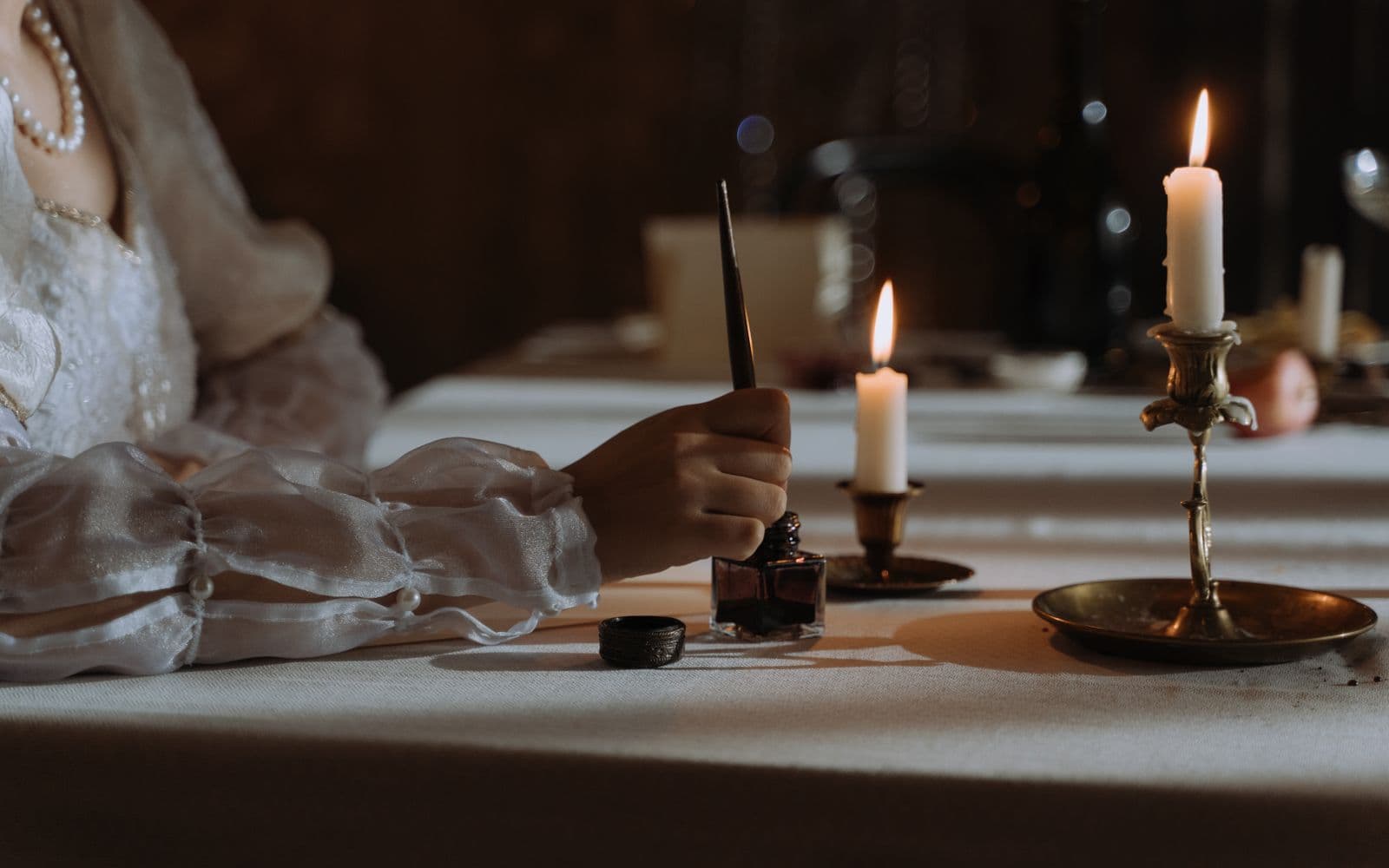
The letters were not usually presented as ordinary correspondence. They were said to be precipitated — an occult process by which writing was impressed onto paper through trained mental and psychic force. A letter might appear in an unexpected place or seem to materialize through the agency of a Master or chela. In Letter 5, K.H. tells Sinnett the letters are "not written but impressed or precipitated and then all mistakes corrected" [1]. In the text corresponding to Barker's Letter 6, he explains that he must "photograph every word and sentence" in his brain, arranging and impressing every letter mentally before it becomes readable [5].
This explanation is doing more than describing a miracle. It is protecting a system. Because if a letter is precipitated through a medium or chela, it may bear traces of the transmitting mind. If Blavatsky's language, spelling, handwriting traits, idioms, or errors appear in a Master's letter, the believer has an answer ready: of course they appear — she was the instrument.
That anticipates the skeptical charge. "These are just Blavatsky's writings," says the critic. "No — they came through her," replies the doctrine of precipitation. That is the hinge.
The letters were produced through occult precipitation rather than ordinary writing.
Letter 5 states they were "impressed or precipitated" [1]; Letter 6 / chronological Letter 12 gives the fuller "photograph every word" account [5].
Precipitation is an internal Theosophical explanation — not independently verifiable by ordinary historical method.
The same logic runs through later channeling: the source's voice may be coloured by the medium, but believers read that colouring as transmission, not authorship. The medium's fingerprints become part of the miracle.
Three answers to one question: who were the Masters?
There are three serious explanations. They are not equally famous, and they are not equally satisfying — but a fair guide has to lay all three on the table.
Koot Hoomi and Morya were real adepts — not gods, not disembodied spirits, but advanced living men in a hidden brotherhood dedicated to humanity's evolution [6]. Pablo Sender stresses a distinction later New Age culture blurs: the original Mahatmas were not "Ascended Masters" in the later American sense — they were embodied, still subject to limits, though vastly advanced [6]. This makes the claim concrete and fragile at once. Remove the Masters and the doctrine loses its warrant, because Blavatsky was not saying "I have a theory" — she was saying "I have teachers."
The Masters were literary masks; the letters were Blavatsky. This was the direction of the 1885 Hodgson Report, which argued the K.H. scripts were written by Blavatsky — except some she could not have written directly, which Hodgson attributed to confederates [7],[8]. Reference sources summarize the case bluntly: Hodgson claimed extensive fraud in producing and delivering the letters, including the shrine with a false back, with Emma Coulomb claiming to have assisted [9]. If true, Theosophy's hidden authority was manufactured by its visible founder.
K. Paul Johnson argued in The Masters Revealed that the Masters were idealized or disguised versions of real people Blavatsky met — proposing, among others, that Morya corresponded to Maharaja Ranbir Singh of Kashmir and Koot Hoomi to Thakar Singh Sandhanwalia, a Sikh leader [12],[13]. This is not settled history — Theosophical critics say his identifications force the evidence [13],[14]. But it gives a third category: not invisible supermen, not pure fiction, but real persons transformed into occult authority.
History enters wearing boots. It leaves wearing a halo.
The Masters were living adepts / literary masks / mythologized real people.
Traditional claim preserved in Theosophical literature [6]; skeptical case in the Hodgson Report [7],[9]; middle hypothesis in Johnson [12].
The Masters' existence as described is not independently established; Hodgson's handwriting case was later criticized; Johnson's identifications are contested and must be labeled hypothesis.
All three feed later esoteric charisma — hidden teachers, ascended masters, and the real person who becomes a screen for more than any body can hold.
The Judge problem: when everyone has letters
The deepest structural problem appears after Blavatsky's death. If hidden Masters can send letters through gifted intermediaries, who decides which letters are genuine? This was not abstract. After Blavatsky died in 1891, William Quan Judge — an important American Theosophist — produced or was associated with new Mahatma letters supporting his position against Annie Besant. Henry Steel Olcott eventually declared those letters fraudulent [9].
Sit with that: the movement's own leadership concluded that at least some later Master-letters were not genuine. But once that is admitted, the real problem is not Judge — it is method. How does anyone tell a genuine Mahatma letter from a manufactured one? Handwriting? Precipitation complicates handwriting. Content? Content can be imitated. Authority? Authority is exactly what is being claimed. Institutional judgment? Institutions are also factional.
The Masters become a source of authority. Then letters from the Masters become weapons in fights over authority. The system begins eating its own tail.
Later Mahatma letters became involved in factional conflict; Olcott declared some Judge-associated letters fraudulent.
Reference sources summarize the Judge episode and Olcott's declaration [9].
The Judge controversy is complex and deserves its own treatment; the key point here is structural.
New messages, new dispensations, new authorized messengers, new succession wars. When the source is invisible, the fight moves to whoever claims the clearest signal.
Harrison and the counter-swing
Now we have to be fair. The skeptical case is serious — but the most famous skeptical investigation is not as secure as its reputation once suggested. In 1986, Vernon Harrison, a professional examiner of questioned documents, published "J'Accuse" in the Journal of the SPR [10]. He was not connected with any Theosophical Society, had been an SPR member for fifty years, and had professional expertise in forgery [11].
Harrison did not prove the Masters existed. He did not prove Theosophical phenomena genuine. He did something narrower: he examined the handwriting case and argued that Hodgson's report was not a reliable scientific investigation but more like a prosecution brief — using dubious evidence, relying on uncorroborated statements from unnamed witnesses, treating conjecture as fact, and failing to seriously consider that someone other than Blavatsky wrote the letters [10].
In a 1997 affidavit, Harrison stated that the letters preserved in the British Library provided primary evidence against which Hodgson's claims could be checked. He examined them both as holographs and through 1,323 colour slides supplied by the Library, and concluded he found no evidence of common origin between the K.H., M., and HPB scripts — treating them, in an ordinary legal case, as different scripts [15].
This is important — but it must not be inflated. Harrison weakens the Hodgson handwriting case. He does not prove the Mahatmas existed, settle the Adyar phenomena, or rescue every Theosophical claim. A bad prosecution is not the same as innocence. It is still a bad prosecution — and that matters.
Harrison undermined the Hodgson Report's handwriting case.
His 1986 and 1997 writings sharply criticized Hodgson's methods; he confined himself to authorship because the letters survive as primary evidence [10],[11],[15].
He did not resolve all questions about Blavatsky, the Coulomb letters, or the paranormal claims at Adyar.
Responsible writing cannot say simply "Blavatsky was proven to have forged the letters." The record is more careful than the legend.
The real point: authority that cannot be cross-examined
Set aside, briefly, whether the Masters were real, and ask a structural question: what kind of authority did Theosophy build when it rooted its teachings in hidden teachers accessible only through selected intermediaries? The answer: an authority that could not be cross-examined.
The doctrine's warrant was the Masters. The Masters were accessible only through Blavatsky, chelas, letters, or later authorized channels. If the letters looked like Blavatsky, precipitation explained it. If letters appeared supporting a faction, rival authorities had to judge them. If critics demanded the Masters appear, believers could say the Masters did not submit to vulgar tests. Every road of verification looped back into the movement's own terms.
This is the politics of invisible authority — not a bug, a feature. An invisible authority can never be decisively defeated, because there is no agreed external test that can count against it. It can affirm doctrine, rebuke doubters, authorize leaders, withdraw into silence when challenged, and generate new teachings indefinitely. It never has to appear under oath.
That makes it spiritually powerful. It also makes it politically dangerous — because authority flows to whoever can most plausibly claim access.
The Masters functioned as an invisible authority structure within Theosophy.
The letters were treated as a major source of doctrine [1],[2],[6]; later authenticity disputes show Master-contact claims could be organizationally decisive [9].
Believers read the Masters' invisibility as spiritual discretion or occult law. Critics read it as unfalsifiability.
The channeler, the prophet, the medium, the guru with private access, the "download" that cannot be audited. A hidden source can be a fountain. It can also be a locked room.
The inheritance: from Mahatmas to Ascended Masters
The Masters did not stay inside the early Society. They migrated. Later Theosophical and post-Theosophical systems developed increasingly elaborate spiritual hierarchies, rays, planetary guardians, and hidden brotherhoods; the language of the Great White Brotherhood and later Ascended Masters became especially influential in twentieth-century American esotericism.
Pablo Sender traces part of this afterlife: Blavatsky introduced the Mahatmas to the West, especially through the Koot Hoomi and Morya correspondence of 1880–1885 [6]. He then follows the transformation — Guy Ballard's "I AM" movement in the 1930s, centered on Saint Germain, and Mark Prophet's Summit Lighthouse from 1958, where "El Morya" appears as an Ascended Master [6]. This is one of Theosophy's most successful exports: not just a doctrine, but a reusable authority format — hidden teachers, cosmic hierarchy, special messengers, messages for the age.
The Theosophical Masters influenced later Ascended Master and New Age movements.
Sender traces the line from the Mahatmas to Ballard's "I AM" and the Prophets' Summit Lighthouse / Church Universal and Triumphant [6].
The Mahatmas and later Ascended Masters are not identical; Sender argues important differences separate them.
The modern seeker who speaks of El Morya, Saint Germain, hidden councils, or channeled dispensations is walking, knowingly or not, through a house Theosophy helped build.
What we can say without pretending
The letters were published by Barker in 1923 and remain foundational documents [1],[2]; attributed chiefly to K.H. and M., directed to Sinnett and Hume, roughly 1880–1884/85 [1],[2],[6].
The primary manuscripts are held at the British Library — Harrison identifying them as Add. MSS 45284–45286 [2],[15].
Some letters were said to be produced through occult precipitation rather than ordinary writing [1],[5].
The Hodgson Report argued Blavatsky wrote the K.H. letters, or that confederates produced those she could not have written directly [7],[8].
Harrison later argued Hodgson's handwriting case was flawed, finding no evidence of common origin among K.H., M., and HPB scripts [10],[15].
The actual authorship and mode of production of the letters remain contested.
Johnson's theory that the Masters were mythologized historical persons is serious enough to discuss, contested enough to label a hypothesis [12],[13],[14].
Whether or not the Masters existed as claimed, they functioned as the invisible warrant behind Theosophical authority.
How to read the letters without getting swallowed
- What is the claim? Metaphysical, historical, institutional, moral, or personal instruction?
- Who benefits? Does the message authorize a doctrine, defend Blavatsky, correct a critic, rebuke Hume, or support a faction?
- What is the evidence? A physical manuscript? A printed edition? A later transcription? A Theosophical or skeptical report? A contested recollection?
- What would falsify it? The hardest one. If every sign of human mediation can be explained as precipitation, ordinary tests lose force.
- Where did the structure travel next? Ascended Masters? Channeling? Spiritual hierarchy? Charismatic authority? The afterlife tells us what the original made possible.
The curtain and the voice
Theosophy did not merely give modern spirituality new ideas. It gave it a new way for ideas to arrive. Not argued. Not researched. Not merely preached. Received — from hidden teachers, through selected intermediaries, for the spiritual future of humanity.
That structure is potent. It bypasses ordinary authorship, ordinary scholarship, ordinary accountability. It also creates one of the great dramas of modern spirituality: the hunger for guidance from beyond the visible world, and the danger of surrendering authority to a voice that never has to step into the light.
The Masters may have been real adepts. They may have been Blavatsky's literary masks. They may have been real historical figures transformed into occult myth. The evidence does not permit a simple final verdict. But the structure is unmistakable.
And from behind it, modern spirituality learned one of its most enduring gestures: I did not invent this. I received it.
Six things to carry forward from this guide:
- I can explain why the Masters were a "technology of authority," not just characters
- I understand how precipitation pre-answers the "it's just Blavatsky" charge
- I can state all three explanations: traditional, skeptical, middle
- I understand why the Judge episode exposes a problem of method, not just a person
- I can state what Harrison did and did not show
- I understand why unfalsifiable authority is powerful and dangerous at once
Where to read further
References
- A. T. Barker, Ed., The Mahatma Letters to A. P. Sinnett from the Mahatmas M. & K.H., 2nd rev. ed. London: T. Fisher Unwin, 1926. link. Accessed Jul. 1, 2026.Primary
- "The Mahatma Letters to A. P. Sinnett (book)," Theosophy Wiki. link. Accessed Jul. 1, 2026.Internal ref
- A. P. Sinnett, The Occult World. London: Trübner & Co., 1881.Primary
- A. P. Sinnett, Esoteric Buddhism. London: Trübner & Co., 1883.Primary
- "Mahatma Letter No. 12," Theosophy Wiki. link. Accessed Jul. 1, 2026.Internal ref
- P. D. Sender, "Mahatmas versus Ascended Masters," Quest, vol. 99, no. 3, pp. 107–111, Summer 2011. link. Accessed Jul. 1, 2026.Primary-adjacent
- R. Hodgson et al., "Report of the Committee Appointed to Investigate Phenomena Connected with the Theosophical Society," Proc. SPR, vol. 3, pp. 201–400, Dec. 1885. link. Accessed Jul. 1, 2026.Primary
- V. Harrison, "J'Accuse: An Examination of the Hodgson Report of 1885," J. SPR, vol. 53, no. 803, pp. 286–310, Apr. 1986. link. Accessed Jul. 1, 2026.Primary-adjacent
- "Mahatma Letters," Encyclopedia of Occultism and Parapsychology, Encyclopedia.com. link. Accessed Jul. 1, 2026.Reference
- V. Harrison, H. P. Blavatsky and the SPR. Pasadena: Theosophical Univ. Press, 1997. link. Accessed Jul. 1, 2026.Scholarly
- "H. P. Blavatsky and the SPR," Quest Magazine, Theosophical Society in America. link. Accessed Jul. 1, 2026.Primary-adjacent
- K. P. Johnson, The Masters Revealed: Madame Blavatsky and the Myth of the Great White Lodge. Albany: SUNY Press, 1994.Scholarly
- "The Masters Revealed…," Quest Magazine, Theosophical Society in America. link. Accessed Jul. 1, 2026.Primary-adjacent
- "K. Paul Johnson's House of Cards?," Quest Magazine, Theosophical Society in America. link. Accessed Jul. 1, 2026.Primary-adjacent
- V. Harrison, "Affidavit," in H. P. Blavatsky and the SPR. Pasadena: Theosophical Univ. Press, 1997. link. Accessed Jul. 1, 2026.Primary-adjacent
Last reviewed for accuracy and source integrity before publication. Grading reflects the historical record, not a judgment on the truth of occult claims.


Comments