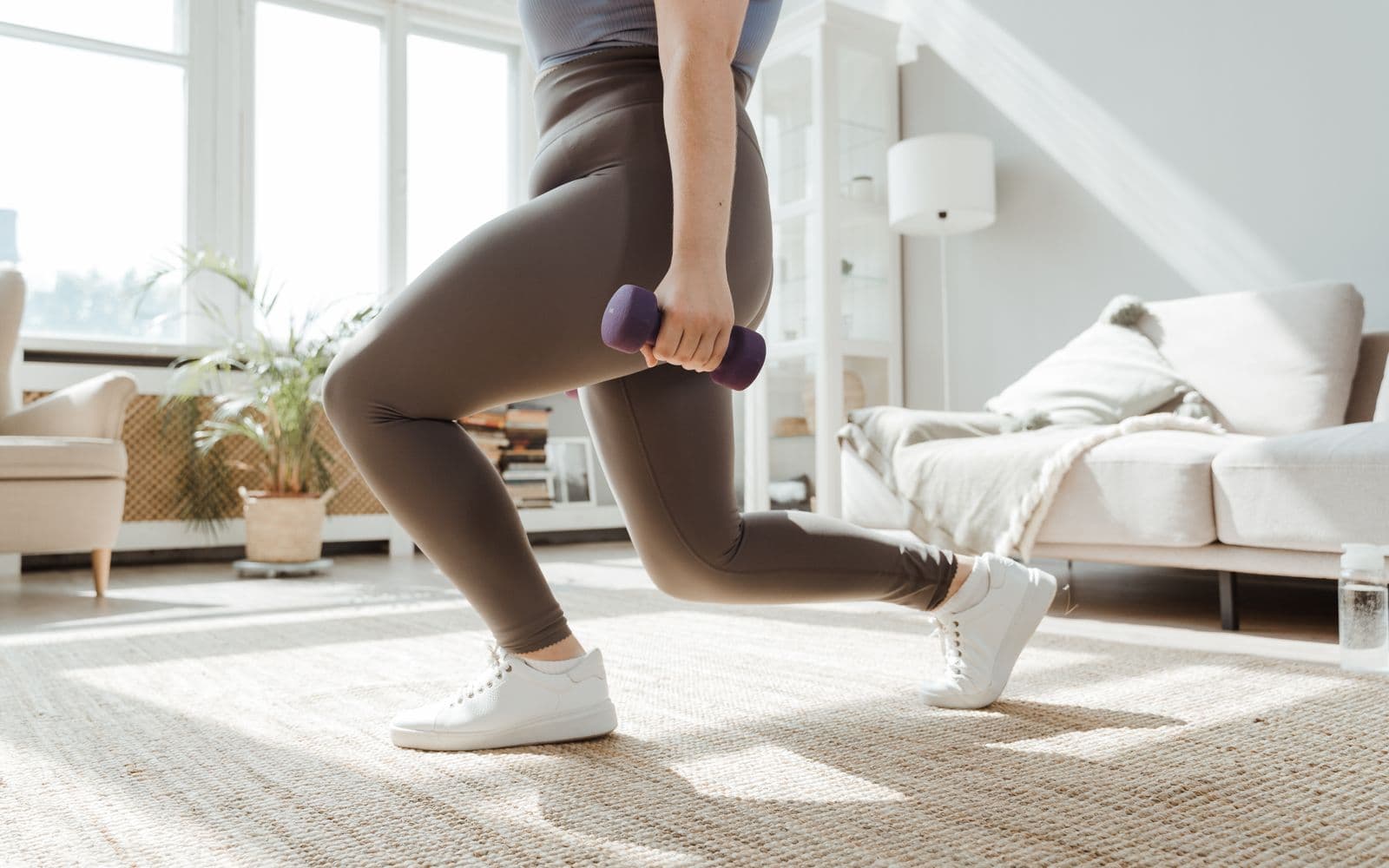
You can build muscle at home. The rules are not magic: train the major movement patterns, make the work gradually harder, get close enough to fatigue to give the body a reason to adapt, eat enough protein and total food, recover, and repeat long enough for the changes to show up.
This guide is general fitness and health information, not medical, physical therapy, sports medicine, nutrition, pregnancy, rehabilitation, or personal-training advice. Talk with a qualified health professional before starting or changing resistance training if you have chest pain, fainting, dizziness, uncontrolled blood pressure, heart disease, diabetes, kidney disease, cancer, osteoporosis, pregnancy or postpartum concerns, recent surgery, unexplained weight loss, an eating disorder, chronic pain, joint instability, neurological symptoms, or any injury that changes how you move.
Stop exercising and seek medical help for chest pain, severe shortness of breath, fainting, sudden weakness, severe headache, new numbness, sharp or worsening joint pain, suspected fracture, calf swelling with pain, or pain that does not behave like normal training soreness. Muscle building should make you more capable over time, not teach you to ignore warning signs.
Most home muscle advice goes wrong in one of two directions.
One version makes it sound too easy: do a few random push-ups, drink a shake, and wait for a new body. The other makes it sound impossible: unless you have a full gym, perfect macros, and a spreadsheet with seventeen tabs, do not bother.
The useful truth is less dramatic. Muscle grows from repeated, progressive resistance plus enough recovery and nutrition. A gym makes loading convenient. It is not the only way to create the signal.
Build a home program around six patterns: squat, hinge, push, pull, lunge or single-leg work, and carry or core. Train each major muscle group at least twice per week if recovery allows, using 2 to 4 full-body or upper/lower sessions. For most working sets, choose a variation that leaves roughly 1 to 3 good reps in reserve; stop earlier when form breaks or pain appears. Start with a modest number of hard sets, track reps and difficulty, and progress by adding reps, slowing tempo, increasing range of motion, adding load with dumbbells, bands, a backpack, or harder body positions, or adding sets only when needed. Eat enough total food, spread protein across the day, sleep, and review progress every two weeks. The best plan is not the most brutal one. It is the one you can progress without getting hurt or quitting.
CDC and ODPHP guidance says adults should do muscle-strengthening activities involving all major muscle groups on 2 or more days per week, alongside aerobic activity for general health. The resistance-training literature adds the hypertrophy details: progressive overload matters, weekly volume matters, training a muscle more than once per week can help distribute that volume, and protein supports gains when paired with resistance training. The home version is just the translation.
Part One: What Actually Builds Muscle
Muscle gain is adaptation. You apply a stress the body can recover from, then make that stress gradually harder.
Three training variables matter most for a home lifter:
| Variable | Plain meaning | Home example |
|---|---|---|
| Tension | The muscle has to produce meaningful force. | A push-up variation hard enough that the last reps slow down. |
| Effort | The set gets reasonably close to fatigue without losing control. | Stopping with 1 to 3 reps left instead of quitting at the first burn. |
| Progression | The work becomes harder over time. | 8 push-ups become 12, then feet-elevated push-ups, then weighted push-ups. |
ACSM's resistance-training progression model emphasizes planned changes in load, volume, rest, frequency, and exercise selection over time. In a gym, load is easy to change. At home, you change the same variables with different tools: leverage, range of motion, tempo, pauses, unilateral work, backpacks, bands, dumbbells, and harder variations.
If a set feels like you could do 15 more clean reps, it is probably practice or conditioning, not much of a muscle-building signal. If the set is ugly, painful, or panicked, it is too hard or poorly chosen. The useful zone is hard and controlled.
Part Two: Get the Right Equipment, Not the Most Equipment
You do not need a garage gym. You do need enough resistance to make the major patterns challenging.
| Tool | What it is good for | Limit |
|---|---|---|
| Bodyweight | Push-ups, split squats, lunges, step-ups, hip thrusts, planks, calf raises. | Pulling and heavy lower-body work become harder to load. |
| Backpack | Weighted squats, lunges, push-ups, carries, rows if sturdy. | Awkward loading and safety if straps or contents shift. |
| Resistance bands | Rows, pulldowns, face pulls, lateral raises, curls, triceps work, assisted mobility. | Resistance changes through the range; anchoring matters. |
| Adjustable dumbbells | Most home strength work with clear progression. | Cost and storage. |
| Pull-up bar or rings | Pulling strength, rows, pull-ups, chin-ups, hangs. | Needs a safe mounting point and shoulder tolerance. |
| Bench or sturdy box | Step-ups, split squats, presses, rows, hip thrusts. | Must be stable; furniture is not always safe. |
A long resistance band, a mini-band, a sturdy backpack, and one pair of adjustable dumbbells or two fixed dumbbells will cover most beginners. Add a pull-up bar, rings, or heavier dumbbells when the plan proves you will use them.
Part Three: Train Patterns Before Body Parts
Body-part splits are not wrong, but beginners do better by learning movement patterns. Patterns make the program balanced and easier to progress.
| Pattern | Beginner options | Harder options |
|---|---|---|
| Squat | Chair squat, goblet squat, tempo squat. | Heavier goblet squat, heel-elevated squat, split squat. |
| Hinge | Hip hinge drill, glute bridge, band pull-through. | Romanian deadlift, single-leg RDL, hip thrust. |
| Push | Wall push-up, incline push-up, dumbbell floor press. | Push-up, feet-elevated push-up, overhead press. |
| Pull | Band row, doorframe row if safe, one-arm dumbbell row. | Inverted row, pulldown, chin-up, pull-up. |
| Single-leg | Step-up, reverse lunge, supported split squat. | Bulgarian split squat, weighted lunge, single-leg hip thrust. |
| Carry or core | Dead bug, side plank, suitcase carry. | Loaded carry, hollow hold, slow mountain climber, anti-rotation press. |
The exact exercise matters less than the progression you can repeat safely. A perfect exercise you cannot load, tolerate, or perform consistently is not perfect for you.
Exercise selection rule
Choose one exercise per pattern that meets four tests: I can do it without sharp pain; I can control the full rep; I can make it harder over time; and I can set it up safely at home.
Part Four: Use Sets, Reps, and Effort Without Turning It Into Ritual
Muscle can grow across a wide range of reps when sets are hard enough and total work is appropriate. Heavy loads are useful, especially for strength. Moderate and lighter loads can also work for hypertrophy when taken close enough to fatigue. That is why home training can work.
| Goal | Useful range | What it should feel like |
|---|---|---|
| Technique learning | 2 to 3 sets of 6 to 10 controlled reps. | Easy to moderate; several reps left. |
| Hypertrophy default | 2 to 4 sets of 8 to 20 reps. | Last reps slow, but form stays clean. |
| Bodyweight high-rep work | 1 to 3 sets of 15 to 30 reps. | Hard near the end; stop before sloppy reps. |
| Strength emphasis | 3 to 5 sets of 3 to 8 reps. | Heavy, crisp, more rest, no grinding early on. |
| Accessory work | 2 to 4 sets of 10 to 25 reps. | Local burn is fine; joints should feel okay. |
Training to absolute failure is not required for every set. Research comparing failure and non-failure training suggests that muscle and strength gains can be similar when effort and volume are managed, while constant failure can add fatigue and degrade form. For home training, use this practical target: most working sets stop with 1 to 3 clean reps left. Push closer to failure on safer accessory moves, not on awkward heavy hinges or movements where form collapse could hurt you.
If you finish a set and think, "I could have done two more clean reps," that is roughly 2 reps in reserve. You do not need perfect accuracy. You need honest effort and repeatable technique.
Part Five: Progress Without Chasing Pain
Progressive overload means the training demand rises over time. It does not mean every workout must be harder than the last one.
At home, progression is often smarter when it follows a ladder.
| Progression lever | Example | When to use it |
|---|---|---|
| Add reps | 3 sets of 8 become 3 sets of 12. | First choice for most movements. |
| Add load | Put books in a backpack or use heavier dumbbells. | When you reach the top of the rep range with clean form. |
| Increase range of motion | Split squat deeper, push-up to a lower surface. | When control is good and joints tolerate it. |
| Slow tempo | Three-second lower on squats or push-ups. | When load options are limited. |
| Add pauses | Pause at the bottom of a split squat or row. | To remove bouncing and improve control. |
| Harder leverage | Incline push-up to floor push-up to feet-elevated push-up. | When bodyweight work gets too easy. |
| Add sets | 2 sets become 3 sets. | When recovery is good and progress stalls. |
Double-progression template
Pick a rep range, such as 8 to 12.
Use the same exercise and load until all sets reach the top of the range with clean form.
Then make the exercise slightly harder and return to the lower end of the range.
Example: backpack goblet squat, 3 sets of 8. Over several weeks: 9, 10, 11, 12. Add weight. Return to 8.
Part Six: Start With Enough Volume, Not Maximum Volume
Weekly hard sets are one of the main dials for hypertrophy. A hard set means a set that is close enough to fatigue to count, with controlled technique.
Meta-analyses on resistance-training volume generally support a dose-response relationship: more weekly sets can build more muscle up to a point, but the cost is fatigue, time, soreness, and recovery demand. Beginners do not need advanced bodybuilder volume. They need enough good work to progress.
| Training age | Starting target | How to adjust |
|---|---|---|
| New or returning after a long break | 4 to 6 hard sets per major muscle group per week. | Add only after soreness and technique are manageable. |
| Consistent beginner | 6 to 10 hard sets per major muscle group per week. | Add sets when reps and load stall for several weeks. |
| Intermediate home trainee | 8 to 14 hard sets per major muscle group per week. | Distribute across more days to preserve quality. |
| High stress or poor sleep | Use the low end. | Recovery is part of the program, not a bonus. |
Frequency is mostly a way to distribute volume. Training a muscle twice per week is a practical default because it gives you more chances to practise and less pressure to cram everything into one exhausting session.
Part Seven: The Eight-Week Home Plan
This plan uses three full-body sessions per week. If three sessions is unrealistic, run two sessions and alternate A and B. If you recover well and want four sessions, split the same work into upper/lower days rather than piling on random extras.
| Workout A | Sets x reps | Notes |
|---|---|---|
| Squat variation | 3 x 8-12 | Goblet squat, backpack squat, or chair squat. |
| Push variation | 3 x 8-15 | Incline push-up, push-up, or dumbbell floor press. |
| Row variation | 3 x 10-15 | Band row, dumbbell row, or inverted row. |
| Hip hinge | 2 x 8-12 | Romanian deadlift, band pull-through, or hip hinge drill. |
| Core or carry | 2 x 30-60 seconds | Side plank, dead bug, suitcase carry. |
| Workout B | Sets x reps | Notes |
|---|---|---|
| Single-leg squat/lunge | 3 x 8-12 each side | Split squat, reverse lunge, step-up. |
| Overhead or angled push | 3 x 8-12 | Dumbbell press, pike push-up, band press. |
| Vertical pull or row | 3 x 8-15 | Band pulldown, chin-up progression, row. |
| Glute bridge or hip thrust | 3 x 10-20 | Add backpack or pause at the top. |
| Accessory pair | 2 x 12-20 | Curl plus triceps extension, lateral raise, calf raise, or face pull. |
| Weeks | Focus | Rule |
|---|---|---|
| Weeks 1-2 | Technique and baseline | Stop with 3 to 4 reps in reserve. Learn the movements. |
| Weeks 3-4 | Build effort | Move most working sets to 1 to 3 reps in reserve. |
| Weeks 5-6 | Progress | Add reps or load when you hit the top of the range. |
| Week 7 | Consolidate | Keep the exercises stable and beat one small previous marker. |
| Week 8 | Review or deload | If tired, reduce sets by about one-third. If fresh, test clean rep improvements. |
Three-day schedule
Monday: Workout A
Wednesday: Workout B
Friday or Saturday: Workout A
Next week: B, A, B
Walk, cycle, or do easy cardio on other days for health and recovery, but do not let cardio crush leg recovery if muscle gain is the goal.
Part Eight: Eat Like You Are Building Something
Training supplies the signal. Food supplies the material. You do not need a perfect diet, but you do need enough total energy and protein to support adaptation.
The 2025-2030 Dietary Guidelines emphasize whole, nutrient-dense foods, including protein, dairy, vegetables, fruits, healthy fats, and whole grains, while reducing highly processed foods with refined carbohydrates, added sugars, excess sodium, unhealthy fats, and chemical additives. For muscle gain, that translates into a simple pattern: protein at most meals, enough carbohydrate to train, fats for energy and hormones, and enough fruits and vegetables to keep the body running.
| Need | Practical target | Examples |
|---|---|---|
| Protein | Spread across 3 to 5 meals or snacks. | Eggs, yogurt, tofu, tempeh, beans, lentils, fish, poultry, meat, cottage cheese, soy milk. |
| Calories | Maintenance or modest surplus if gaining muscle and weight. | Add oats, rice, potatoes, pasta, olive oil, nuts, avocado, smoothies, or extra portions. |
| Carbohydrates | Enough to support hard training. | Rice, oats, bread, fruit, potatoes, beans, pasta, cereal. |
| Fats | Include daily, especially if appetite is low. | Olive oil, nuts, seeds, nut butter, avocado, dairy, tahini. |
| Hydration | Enough that training quality does not suffer. | Water, milk, fortified soy milk, soups, fruits, electrolyte drink if sweat is high. |
Morton and colleagues' 2018 meta-analysis found that protein supplementation can enhance resistance-training gains in muscle size and strength, with benefits appearing to plateau around 1.6 grams per kilogram per day for fat-free mass in the analyzed data. That does not mean everyone must chase a precise number. It means protein adequacy matters, especially if you were under-eating it before.
Simple muscle meal template
Protein anchor + starchy carbohydrate + fruit or vegetable + fat or flavor.
Example: eggs, toast, avocado, fruit.
Example: tofu rice bowl with vegetables and peanut sauce.
Example: yogurt, oats, berries, nuts, honey.
Example: chicken or beans, potatoes, salad, olive oil dressing.
Part Nine: Recover Like It Counts
Muscle is not built during the hardest rep. The rep is the signal. Adaptation happens when the body has time and resources to respond.
| Recovery problem | What it looks like | Fix |
|---|---|---|
| Too much soreness | Movement is limited for days after every workout. | Reduce sets, range, or failure training; progress slower. |
| Poor sleep | Performance drops, appetite changes, mood worsens. | Lower volume temporarily and protect bedtime basics. |
| Joint irritation | Sharp, local, or worsening pain around a joint. | Stop the painful variation, change range or exercise, seek care if persistent. |
| No performance progress | Same reps and load for weeks. | Check food, sleep, exercise selection, effort, and weekly volume. |
| Always tired | Training feels like a debt. | Deload: cut sets by 30% to 50% for a week and rebuild. |
Some soreness is normal, especially when a movement is new. Chasing soreness is a poor program. Chasing better reps, more controlled load, and stable recovery is better.
Part Ten: Track the Things That Actually Tell You Something
You do not need a complicated dashboard. You need enough records to know whether the plan is progressing.
| Track | Why it matters | How often |
|---|---|---|
| Exercise, sets, reps, load or variation | Shows progressive overload. | Every workout. |
| Reps in reserve or effort | Shows whether sets are actually hard. | Most working sets. |
| Body weight trend | Useful if gaining muscle mass is paired with weight gain. | 2 to 4 mornings per week, optional. |
| Photos or measurements | Slow body changes are hard to see day to day. | Every 4 weeks, optional. |
| Sleep and soreness | Shows recovery capacity. | Quick note after workouts. |
| Pain flags | Prevents small issues becoming injuries. | Immediately. |
Workout log line
Goblet squat: 30 lb backpack, 3 x 10, 9, 8. RIR 2, 2, 1. Knees felt fine. Next time: repeat until all sets hit 10, then add weight.
Part Eleven: Fix Plateaus Without Rebuilding Your Identity
A plateau is not a cosmic verdict. It is a troubleshooting prompt.
Change one thing at a time. Add a set, make a variation harder, improve protein, fix sleep, or reduce junk volume. If you change everything, you learn nothing.
Part Twelve: Keep Supplements in Their Place
Protein powder can be useful if it helps you reach protein targets. Creatine monohydrate has evidence for strength and power in many adults, but it still belongs behind the basics: training, food, sleep, and consistency.
Be much more cautious with pre-workouts, testosterone boosters, SARMs, prohormones, fat burners, and muscle-building products that promise drug-like effects. NCCIH warns that supplements may interact with medications, pose risks for some medical conditions, and that products marketed for bodybuilding may contain prescription drugs or other ingredients not listed on the label.
| Supplement | Reasonable use | Pause when |
|---|---|---|
| Protein powder | Convenient protein when meals fall short. | You have kidney disease, allergies, digestive symptoms, or disordered eating concerns. |
| Creatine monohydrate | Possible support for repeated high-intensity efforts and strength training. | You have kidney concerns, take interacting medications, are pregnant, or lack clinician clearance. |
| Pre-workout caffeine | Occasional energy support. | It disrupts sleep, anxiety, heart rate, blood pressure, or medication safety. |
| Hormone-like products | No casual use. | Avoid unless prescribed and monitored by a qualified clinician. |
If a product sounds like it works like a drug, treat it with drug-level caution. Your home program does not need a risky chemistry subplot.
Part Thirteen: Common Questions
"Can bodyweight exercises really build muscle?"
Yes, especially for beginners and when the variations are hard enough. The challenge is progression. A push-up can be easy, moderate, or brutal depending on incline, range, tempo, pause, load, and proximity to fatigue.
"Do I need to train to failure?"
No. You need sufficient effort. Stopping with 1 to 3 good reps left is a strong default. Save true failure for safer exercises and occasional tests, not every set of every workout.
"How fast will I see results?"
Strength and coordination can improve within weeks. Visible muscle usually takes longer: often months of consistent training, food, and recovery. Beginners can change faster than trained lifters, but the mirror is still a lagging indicator.
"Should I bulk?"
If you are lean, under-eating, or not gaining strength, a modest calorie surplus may help. If you are already gaining body weight quickly or you mainly want strength and shape, maintenance calories with enough protein may be a better first phase. Use weight trend, performance, and comfort as feedback.
"What if I only have 20 minutes?"
Use two or three compound movements and one accessory. Example: split squat, push-up, row, then lateral raise or curl. Hard, repeatable work beats a perfect plan you never start.
"Do I need soreness?"
No. Soreness is not a scoreboard. Progress in reps, load, control, range of motion, and recovery matters more.
The Point
Building muscle at home is not a hack. It is training discipline translated into your actual life.
Pick safe exercises. Train the major patterns. Work hard enough. Progress gradually. Eat enough. Sleep. Track the basics. Avoid supplement fantasies. Let the program become boring in the best possible way.
The gym is one tool. The real machinery is repeated, recoverable effort.
References
[1] StormIt, "How To Do Almost Anything."
[2] CDC, "Adult Activity: An Overview."
[3] ODPHP, "Physical Activity Guidelines for Americans."
[4] American College of Sports Medicine, "Progression Models in Resistance Training for Healthy Adults."
[9] ODPHP, "Current Dietary Guidelines."
[10] USDA National Agricultural Library, "DRI Calculator for Healthcare Professionals."