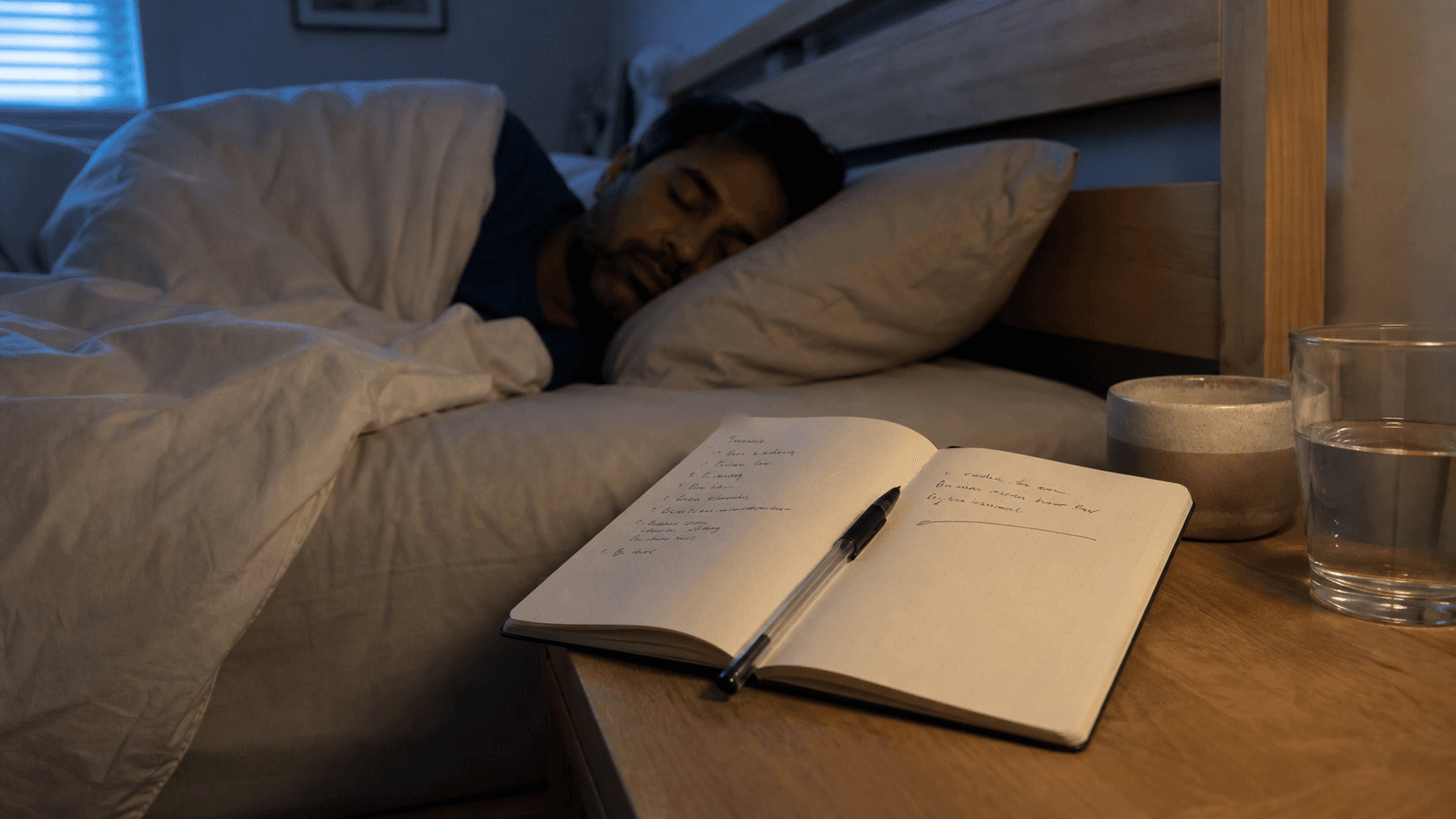
You spend waking hours meditating, journaling, breathing and stretching to fix your inner world. Which is a little strange, because a lot of that same work is what your brain gets on with at night, for free, while you're unconscious. Here is a ten-minute habit for handing the day off to the shift that works while you sleep — grounded in the research, and honest about where the research stops.
This is a personal write-up and general wellbeing information — not medical advice, and not a treatment for any sleep disorder. It sits on top of ordinary sleep hygiene and cannot rescue starved sleep. If your nights are the site of real insomnia, trauma, or dreams you dread, a bedtime habit is not the fix — that is a reason to see a qualified clinician, and doing so would be a far better use of your effort than anything on this page. Chronic insomnia has an effective first-line treatment (cognitive behavioural therapy for insomnia), and a clinician can help you get it.
If sleep loss ever comes with thoughts of self-harm, treat that as urgent. In Canada and the United States, call or text 988 to reach the Suicide Crisis Helpline. Elsewhere, contact local emergency services or a local crisis line.
This is the thirty-third guide in the How To methods library,[1] and it started the way the others didn't: I tripped over it. I keep a journal — part diary, part lab notebook, because I run little experiments on myself. A meditation stretch, a breathwork stretch, one entire winter of cold showers I still resent. One evening I finally sat down and read two years of those entries end to end, with one question: of all these practices, which one actually works?
I never got a clean answer, because something else kept getting in the way. My best mornings — the entries where I sound clear and patient, where decisions seem to have made themselves overnight — didn't follow my most disciplined evenings or my most virtuous dawns. They followed particular kinds of nights. And the scattered mornings turned up even inside my most disciplined weeks, whenever the night before had been a mess. Two years of self-experiments, and the thing that predicted the most wasn't any of the experiments. It was the sleep in between.
Then the line that made me put the notebook down. Over and over, a problem I'd written out at night in a state — "I have no idea what to do about X" — shows up in the next morning's entry already smaller. Sometimes gone. Slept on it. Obvious now. I'd written some version of that dozens of times over two years and never noticed it was probably the most-repeated sentence I own. When I went and read the actual sleep literature, the pattern mostly survived, which was humbling: a lot of what I'd been crediting to meditation and journaling turns out to be work the brain does overnight anyway.
I call it RELAY because that is what it feels like: you hand the day off to the shift that works while you're asleep, so your mornings can point at something more useful than your own reflection.
Ten minutes at lights-out, two at dawn, one notebook by the pillow. Lying down, replay the day backwards like a film you only watch. Then empty every open loop onto the page — tomorrow's tasks, the email you owe, the worry on its ninth lap. Lay exactly one thing on the night: a single question, written plainly and then set down, not solved. Anchor down with a slow body-scan until you cross over. And in the morning, before the phone and before your feet hit the floor, yield the harvest — lie still for a minute and catch the dream scrap, the mood, the flat little "oh, obviously" that sometimes arrives. Two rules that don't bend: one thing, not ten; and fill the eight hours, never cut them.
The wellness industry mostly sells you the day-shift version
Walk the self-improvement aisle and a lot of it, once you notice, is asking your waking hours to do maintenance your sleeping brain already does. Four examples, with sources — because I didn't believe my own journal until I'd checked them.
Overnight, not on the cushion
People meditate to take the edge off a hard day; the brain does its own version overnight — the idea, from Walker and van der Helm's review, that sleep reprocesses charged memories so the feeling fades while the memory stays. The blunt evidence is what happens when you block it: in one small imaging study, sleep-deprived people's amygdala fired about 60% harder at aversive images than rested people's did, with the calming link to the prefrontal cortex gone.[2]
It sticks while you're out
You review and drill to make something stick; sleep is a good part of when it actually sticks. The old musician's-trick version is real enough — you sleep, and play the passage a bit cleaner the next day without having touched it in between.
The night shift takes out the trash
People buy supplements for "brain fog" while the brain's own waste-clearance system does its main shift during sleep — the glymphatic finding, though it was shown in mice and the human picture is still being filled in.[3]
Slept on it, obvious now
A Nature paper actually titled Sleep Inspires Insight found people were more than twice as likely to spot a hidden shortcut in a task after a night's sleep than after the same hours awake.[4]
I won't oversell the join between these. Each study is about one narrow thing, and stringing them into "the wellness industry sells you overtime" is my interpretation, not a finding — but it's the interpretation my own two years kept pointing at. There may be a simpler reason waking practices dominate the culture anyway: they give you something visible to do. Sleep feels passive, even though the brain plainly isn't, and passive is a hard thing to sell and an easy thing to overlook.
We only ever count the hours
We talk about sleep almost entirely as a number. Get your eight. Protect the eight, absolutely — nothing here involves sleeping less. But duration is only one part of the story, and it's the only part anyone measures. What you carry into those hours seems to shape what the brain does with them, and that part goes mostly unmanaged, because it rarely occurs to anyone that they have a say in it. That's the whole opening this method works in: not a secret the labs are keeping, just a habit of watching only the length of the night and never what we bring to it.
Why bother, if it isn't about serenity
One detour before the steps, because to me it's the actual point. The reason to want a steady inner world isn't the inner world. The point of feeling steadier isn't to spend even more time studying your own steadiness; it's to have some attention left over for the work and the people around you. A settled person can finally face outward — toward the family, the person at the counter, whatever bit of the world they're standing in front of. Inner balance isn't the destination; it's closer to the equipment you need to carry something that isn't you.
Which is what made my 5:30 era quietly daft, and I can read it now in my own writing: I was spending my richest, sharpest hours turned inward on myself, then meeting the real world with what was left over. If the night can take on a good share of the maintenance — and the research says it can, if you give it something to work with — then the days come free for the part you can only do awake. You don't get up and spend ninety minutes repairing yourself. You get up already seen to, and go be of some use.
The RELAY Method
The short version: ten minutes at lights-out handing the day over, two minutes at dawn picking up what came back. All you need is a notebook within reach of the pillow. One honest caveat: I keep calling it a "shift" you "hand things to." That's a way of talking about it, not a claim about the wiring — I don't think the brain literally works a job or reads your notes. But the as-if version turns out to be a useful way to actually do the thing.
R — Replay the day (about 2 minutes)
Lying down, eyes shut, run the day backwards like a film you're only watching — from now back to waking. Don't score it or fix anything; just let it go by. What you turn over right at the edge of sleep may be more likely to stay active through the night, so it's worth choosing on purpose. Skip it, and the night runs on whatever was loudest by itself — which, for me, is usually the anxious stuff.
E — Empty the deck (about 3 minutes)
Open the notebook and get every open loop out of your head and onto the page — tomorrow's tasks, the email you owe, the worry on its ninth lap. Not organised into anything. Just out. This is the step with the most direct evidence behind it. In a sleep-lab study at Baylor, people who spent five minutes before bed writing tomorrow's to-do list fell asleep faster than people who wrote about what they'd already done — and the more specific the list, the faster they dropped off.[5] One likely reason is plain: once the tasks are written down, your mind no longer has to keep rehearsing them so it won't forget.
L — Lay one thing on the night (about 1 minute)
Pick one thing. Just one. A question you're stuck on, a decision, a knot in some project. Write it at the top of the page as a plain question, and then — this is the bit that feels a little silly; do it anyway — set it down for the night and let it be. You've written it out; you're not the one solving it before you fall asleep. There's research here too, and I like that it's honest about its limits. In Deirdre Barrett's dream-incubation work, people held a self-chosen problem in mind each night for a week; about half later recalled a dream related to the problem, and roughly a third felt a dream had helped them solve it, with personal dilemmas doing best.[6] A third over a week isn't a guarantee — but for one minute of effort a night I'll take those odds, and that's before the insight effect, which turns up whether or not anyone remembers dreaming.[4]
A — Anchor down (about 3–4 minutes)
Now stop thinking and drop into the body. Let attention move slowly from scalp to feet, each part going heavy as you breathe out. If you know yoga nidra or NSDR, this is that, done in the doorway between awake and asleep; if you don't, the plain version does the job. To be clear about what this is: nobody does yoga while unconscious, and anyone promising benefits "during deep sleep" is selling you something. The threshold — the drifting-off part — is where a practice can genuinely sit, and it's been studied: in a small 2023 pre/post study, beginners who practised yoga nidra showed better sleep along with sharper cognitive and memory scores.[7] Its practical job here is just to bring your arousal down so you cross over cleanly instead of wired. If you already meditate in the morning, this is where I'd move that time — it costs you nothing, since you're lying there anyway.
Y — Yield the harvest (about 2 minutes, at dawn)
The moment you wake, before the phone, before your feet hit the floor: lie still and catch what's there. A dream scrap, a mood, the odd first thought, and now and then something useful connected to last night's question — which for me usually turns up not as a thunderclap but as a flat little "oh, obviously, do it this way." Get it into the same notebook, however rough. Don't skip this one. Morning material is real but it burns off within a couple of minutes, painted over the moment you start planning the day or reach for a screen — and without the morning note, you've no reliable way to tell whether any of this is doing anything at all.
Where it goes wrong
Every practice has failure modes; I've personally hit all five of these, so treat them as field notes.
You start solving, not handing off
At Empty or Lay you begin problem-solving, and half an hour later you're wide awake running a strategy meeting with yourself. The fix is almost embarrassingly physical: write the question down and put the notebook on the floor, out of reach. Something about the reaching being annoying enough settles it.
You give the night a whole list
More than one question and you lie there mentally busy instead of drifting off. The fix: one. Just one.
You skip the morning catch
The bedtime half is pleasant; the morning half has to compete with your phone, and some mornings the phone wins. The fix: keep the first ninety seconds of the day screen-free and notebook-first. It's the only thing that reliably saves it.
You try to sleep less
Don't. This fills the eight hours, it doesn't shorten them. Trimming sleep to "optimise" it is like tuning an engine by draining the oil, and the science on sleep loss is some of the least forgiving in all of health.
You miss a night
You'll crash sometimes with none of it done. The line you already know if you've read anything else I've written: you pick it up tonight, not "properly, next week." A missed night only means the shift ran on autopilot — which it was going to do anyway.
What it isn't
It isn't a substitute for ordinary sleep hygiene. Dark, cool room; a consistent schedule; seven-to-nine hours — this sits on top of decent sleep and can't rescue starved sleep. If the basics are the problem, start there.[8]
It isn't sleep-learning. You can't run a language tape overnight and wake up fluent; people tried, and it didn't hold up. Sleep works on what you actually engaged with while awake — the Lay step does something because you did the thinking during the day and handed over a problem you'd already loaded, not because the night invents knowledge out of nothing.
And it isn't therapy. If your nights are the site of real insomnia, or trauma, or dreams you dread, a bedtime habit isn't the fix and I won't pretend it is. RELAY is for ordinary sleepers who want to experiment with what they carry to the edge of sleep, and what they notice on waking.
How it actually went for me
I can't give you a clean two-week arc, because I don't have one — this came out of my own journals, not a trial of other people, and I'd be inventing numbers if I told you what "most users" experience.
What I can tell you is the order things happened in. The Empty step paid off first: I was falling asleep with fewer unfinished thoughts doing laps, which matches the Baylor finding and was enough on its own to keep me going.[5] The morning catches were slower and much less reliable. Some mornings gave me nothing. Some gave me a clearer version of the question rather than an answer, which I've come to think is worth almost as much. And every so often — not on a schedule I could predict — I'd wake up already knowing what to do about something I'd gone to bed stuck on. So I won't promise you a timeline. The falling-asleep part showed up quickly enough to be worth it by itself; the rest arrived unevenly, and the unevenness is probably the most honest thing I can tell you about it.
The whole thing on one page
| Step | When | The move |
|---|---|---|
| R — Replay | in bed, ~2 min | Watch the day run backwards, lightly, no fixing. |
| E — Empty | in bed, ~3 min | Every open loop onto paper (bedtime to-do lists sped sleep onset — Scullin, 2018). |
| L — Lay | in bed, ~1 min | One clear question, left for the night (Barrett's incubation work; the Wagner insight study). |
| A — Anchor | in bed, ~3–4 min | Body-scan down into sleep — yoga nidra / NSDR territory. |
| Y — Yield | at dawn, ~2 min | Catch the morning's scraps before the phone does. |
Two rules I don't bend: one thing, not ten · fill the hours, never cut them.
The handoff (10 min, lights-out): replay the day backwards → empty every loop onto paper → lay one question on the night → anchor down with a body-scan.
The catch (2 min, at dawn): before the phone, lie still and write down the scrap, the mood, or the flat little "oh, obviously."
A few reasonable questions
Isn't this just a bedtime routine?
A routine settles you for sleep. This also aims the night at one problem and then goes back the next morning to collect anything that came of it — the loading and the catching are what make it more than wind-down.
Can you really solve problems in your sleep?
Sometimes, and not to order. Barrett's honest figure was about a third of problems helped over a week, personal ones best,[6] so treat the Lay step as improving your odds rather than placing an order. Some mornings you get an answer, some a better question, some nothing at all. Across a month it's earned its one minute a night for me.
I don't know yoga nidra.
The plain heavy-body scan gets you to the same place, and there are free guided NSDR tracks if you'd rather follow a voice.
How does this sit with the ATMAN piece?
They're complementary rather than a matched set. The ATMAN Method is a bit of deliberate daytime reflection — a set half-hour spent consulting your own steadier voice.[9] RELAY is about what happens when you carry a question into sleep instead. They land on different ends of the day, which is partly why I use both.
Can an app do it for me?
It can guide the Anchor and hold your notes, but it can't do the Replay, the Lay or the Yield, because the raw material is your day, your question, your morning. The handoff is between your daytime self and your sleeping one, and there's no seat in that for an app.
The turning
I still keep the journal. The entries read differently now — the morning pages aren't damage reports the way they used to be, because a lot of the repair happens overnight now that I brief the night on purpose instead of by accident. The mornings mostly point outward, at the work and the people actually in front of me. It took me two years of notebooks to notice what my own sleep had been quietly doing with the scraps I left it. The one thing this article can really offer is that you don't have to take the two years.
Notebook by the pillow. Watch the day back. Empty your head onto the page. Leave one question for the night. Sink into the body. And in the morning, before the day gets hold of you, lie still for a minute and see what came back.
References
[1] StormIt, "How To: The Practical Methods Library."
[8] StormIt, "How to Fix Your Sleep in 14 Days," How To methods library.