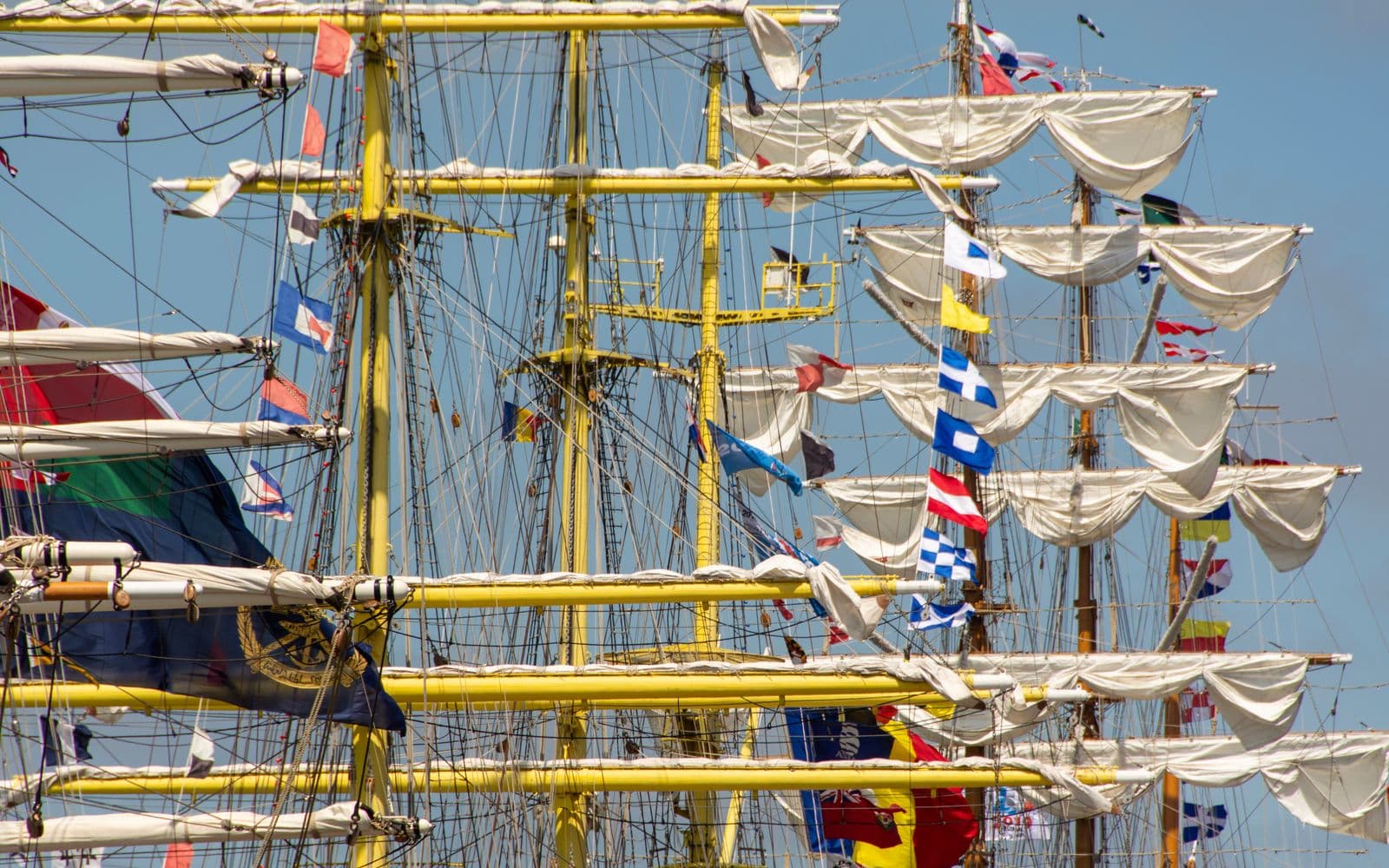
The Bear said nothing. It had not come to save the Eagle — it had come to sharpen its claws in water the ice could not reach.
Cold Open
In the early autumn of 1863, New York looked out past its harbor and saw foreign masts on the eastern horizon. They came in under a flag the city did not expect.
Russian warships.
The first to appear, in September, was the frigate Osliabia[1][2]. About two weeks later came the larger Russian cruiser squadron under Rear Admiral Stepan Lisovsky, with the great screw frigate Alexander Nevsky as flagship[1]. New York did not panic. It cheered. The city sent committees out to welcome the visitors. Bands played the Russian anthem across the water, Russian sailors climbed the rigging to answer with cheers, and the flagship’s band answered with “Yankee Doodle”[1].
Then the news grew stranger. Across the continent, in San Francisco, another Russian squadron was arriving in pieces. One ship, the Novik, wrecked near Point Reyes in heavy fog before reaching the bay[1][3]. Admiral Andrei Popov arrived on October 12 aboard the Bogatyr, and the rest of his diminished Pacific squadron followed over the weeks that came after[1][3]. A dozen Russian ships had been sent toward American waters; eleven completed the visit[1].
To a country already split open by civil war, the sight felt miraculous.
Russian warships on both American coasts.
New York and San Francisco.
Atlantic and Pacific.
The Bear, it seemed, had crossed the world to stand beside the bleeding Eagle. Abraham Lincoln’s Secretary of the Navy, Gideon Welles, wrote the mood of a frightened Union into four famous words: “God bless the Russians”[4].
To the war-weary North, it looked like the grandest gesture of friendship in American memory. It looked like one European great power, perhaps the only one, had decided not merely to sympathize with the Union but to anchor steel, steam, cannon, and sailors in its harbors. It looked like a warning to Britain and France. It looked like a shield thrown over the republic at the exact moment the republic feared being torn apart forever.
For half a century, that was the story Americans told themselves.
Russia came to save the Union.
The Tsar’s fleets carried secret orders.
If Britain or France joined the Confederacy, the Russian ships would fight for Lincoln.
It was a beautiful story.
There was only one problem.
It was not true.
Or rather, it was not true in the way Americans wanted it to be true.
The Bear had not come to save the Eagle. The Bear had come because of Poland.
It had come because Britain and France were circling Russia over a rebellion in the Russian Empire[5]. It had come because the Russian navy feared being trapped in its own icy harbors if war broke out in Europe[5]. It had come because New York and San Francisco were useful, friendly, neutral, ice-free harbors from which Russian ships could burst into the oceans and attack British and French commerce if the crisis became war[1][5].
America was not the mission.
America was the sanctuary.
And yet, history has a taste for crooked miracles. Because the rescue that Russia never intended still helped happen. A fleet that came for itself became, by accident, one of the most dramatic symbols of friendship the Union ever received.
This is the story of the most misunderstood gift in the history of the Eagle and the Bear: a rescue that was actually an escape, a friendship that was actually strategy, and a handful of Russian sailors who died on American ground even though their empire had not come to die for America at all.
IThe Darkest Water
To understand why New York wept at the sight of those ships, you have to stand inside the Union’s fear in 1863.
The tide of the Civil War had only just begun to turn. In July, Gettysburg had broken Robert E. Lee’s invasion of the North, and Vicksburg had given the Union control of the Mississippi. But a tide turning is not the same as victory. The war was still enormous, bloody, uncertain, and bitter. The North was exhausted. The South was not dead. Lincoln still faced military strain, political anger, racial violence, draft resistance, and the grinding knowledge that every battlefield success had been paid for in piles of bodies.
And beyond the battlefield waited the nightmare that haunted Union diplomacy from the beginning:
Europe.
Britain and France watched the American war with cold, interested eyes. Their governments remained officially neutral, but Confederate hopes fed on British shipyards, French ambition, cotton diplomacy, and the belief that a divided United States would suit the Old World very well. The Confederacy sought diplomatic recognition from Britain and France, and U.S. officials understood that recognition would lend credibility to Confederate independence and open the door to deeper trade and possible intervention[6].
Britain was especially dangerous because of the sea. British shipyards built Confederate commerce raiders under disguises thin enough to make a lawyer sweat. The most famous was the CSS Alabama, launched in 1862, which captured dozens of Northern merchant ships before being sunk in 1864. Other British-built Confederate ships also attacked Northern commerce, and the dispute later became the Alabama Claims[7].
France carried a different kind of danger. Napoleon III was using the American Civil War as cover for his intervention in Mexico. In 1862, he maneuvered to establish a French client state there, later installing Maximilian of Habsburg as emperor. The U.S. government objected, but during the Civil War it avoided direct conflict with France because it did not want to push Napoleon toward the Confederacy[8].
So the Union’s fear was not fantasy. If Britain and France formally recognized the Confederacy, or worse, if they intervened at sea, the war could change overnight. The blockade might crack. Confederate legitimacy might harden. European trade might flow more openly. The survival of the United States would no longer be only a battlefield question. It would become a world question.
And then, into that fear, the Russian fleets arrived. Is it any wonder the city cheered? The Union looked at those Russian masts and saw not just ships.
It saw reassurance.
It saw a great power that had not joined Britain and France in cold neutrality.
It saw a counterweight.
It saw a friend.
Or, at least, something close enough to a friend to warm the blood.
IIThe Grandest Season
The welcome became a festival. New York did not merely offer polite diplomatic courtesies. It threw open its civic chest and poured out gratitude by the bucket. There were receptions, parades, dinners, flags, bands, speeches, banquets, and oceans of toast-making. Harper’s Weekly admired the Russian officers and sailors, and the American press treated the visitors as splendid men from a friendly power. The Naval Institute’s account describes a banquet at Astor House, a New York ball for thousands, Mary Todd Lincoln’s visit aboard the Osliabia, and a White House reception for the Russian officers[1].
On November 5, 1863, New Yorkers honored the Russians with a grand ball at the Academy of Music. It became one of the great social spectacles of the season, and Harper’s Weekly covered the festivities lavishly — Winslow Homer’s engraving of the ball survives to this day[9].
San Francisco answered in its own gold-rush key. Popov’s Pacific squadron was welcomed by a city terrified of raiders and hungry for protection. California Governor Leland Stanford was guest of honor at a grand ball for the Russian officers on November 17, an event that seated roughly 2,400 guests[1].
Beneath the champagne, a deeper symbolism began to sparkle. In 1861, Tsar Alexander II had abolished serfdom in Russia. The Library of Congress notes that about 23 million serfs gained personal freedom and a grant of land, though the reform remained limited and did not help most former serfs as much as reformers hoped[10][12].
In January 1863, Lincoln’s Emancipation Proclamation declared enslaved people in the rebellious states free. The National Archives emphasizes both its force and its limits: it applied only to states that had seceded, exempted some areas already under Union control, and depended on Union military victory to make freedom real[11].
Still, the symbolic pairing was irresistible.
Alexander the Tsar Liberator. Lincoln the Great Emancipator.
Russia freeing serfs. America striking at slavery.
The Bear and the Eagle, two vast continental powers, both struggling with rebellion, bondage, reform, and the question of what kind of future their empires would become. The comparison was powerful. It was also imperfect.
Russian serfdom and American chattel slavery were not the same system. The emancipation of Russia’s serfs and the emancipation of enslaved African Americans were not the same process. Both reforms were limited, uneven, and haunted by the old worlds they did not immediately repair. But people do not drink nuance at a ball. They drink symbols. And in 1863, Americans drank deeply.
Out of that season grew the legend: somewhere in the admirals’ strongboxes, people whispered, lay sealed orders from the Tsar. If Britain and France joined the South, the Russians would fight for the Union. The ships had come not only to visit, but to defend.
It was folklore. No such written ultimatum to Britain or France has ever been found in the Russian archives[4]. And like much folklore, it grew from a real event whose real meaning had been buried beneath flowers. Because five thousand miles away, in a city of ice, the true reason those ships had sailed was not America. It was the ghost of Crimea.
IIIThe Ghost of Crimea
The Russian fleets came because Poland rose.
In January 1863, Polish nationalists launched an uprising against Russian rule. The rebellion spread through lands of the former Polish-Lithuanian Commonwealth and became a crisis not only inside the Russian Empire, but across Europe. Britain, France, and Austria pressed St. Petersburg with diplomatic notes, demanding concessions and treating the Polish question as a European matter rather than a purely Russian domestic affair[5]. Russia insisted the opposite: Poland was inside the empire, and foreign powers had no right to interfere.
The dispute grew dangerous. For Russia, the crisis carried the smell of an old humiliation. Less than a decade earlier, Russia had fought Britain and France in the Crimean War. That war had revealed painful Russian weakness. It had also taught a naval lesson written in salt and shame: the Russian fleet, trapped in home waters, could be bottled up by stronger Anglo-French naval power[5]. A navy trapped in port is not a navy. It is a row of expensive coffins.
Now the same danger seemed to be returning. If Russia went to war with Britain and France over Poland, its Baltic ships could be locked in the Gulf of Finland. Its Pacific ships could be isolated. The Bear’s claws would be frozen inside its own paw.
So Russia made a plan.
Not a plan to save Lincoln.
A plan to save the fleet.
IVThe Secret Orders
The central naval logic came from Grand Duke Konstantin, the Tsar’s brother and head of the Russian navy, and from Naval Minister Nikolay Krabbe[5].
If the ships stayed home, they might be trapped.
If they escaped to distant neutral harbors before war began, they could become commerce raiders.
This was the Russian answer to British sea power: do not fight the Royal Navy head-on. Slip into the oceans and attack the merchant trade that fed the British Empire. Make war expensive everywhere.
Krabbe’s reasoning was cold and clear. The fleet could be best used by preying on British and French commerce. If it remained at home, it would likely be blocked in. Therefore it had to be sent away to a better position before the trap closed. Alexander II approved the proposal in July 1863, and the orders sent Lisovsky to New York and Popov to San Francisco[5].
Now the choice of American harbors makes sense.
New York gave Russia a position near Atlantic trade.
San Francisco gave Russia a position in the Pacific.
Both were neutral, friendly, ice-free, close to repair, and far from the immediate reach of European blockade.
America was not the object of the operation. It was the stage. The Russian squadrons were not sailing into the Civil War as volunteers for Lincoln. They were preparing for a possible European war against Britain and France. If that war came, they would leave American waters and strike enemy commerce[1][5].
The Bear did not cross the ocean to guard the Eagle’s nest. It crossed the ocean to keep its claws from being frozen shut.
VThe Beautiful Silence
The Russians were not especially eager to explain all of this to their American hosts. And why would they be? The Union was grateful. The celebrations were useful. The friendship looked splendid in newspapers. The Russian officers could enjoy the warmth without paying the price of honesty.
Mikhail Katkov, editor of Moskovskie Vedomosti, put the Russian position with icy bluntness. The Polish problem, he argued, had compelled Russia to send part of its military forces into American waters. Russia had anchored there “without either aggressive or altruistic intentions” and had gone merely for its own convenience[5].
That is the dagger hidden in the bouquet.
Without altruistic intentions.
For its own convenience.
No American banquet committee would have embroidered that onto a banner. Frank Golder later argued that the Russian officers avoided mentioning Poland during the celebrations, and that this silence served diplomacy beautifully[4]. It concealed the true purpose of the visit and strengthened the American belief that the fleet had come for the Union’s benefit.
This was not exactly deception. It was more elegant than that. Russia let America believe what America wanted to believe. The Bear did not say, “We came to save you.” It simply accepted the wine, the music, the parades, the speeches, and the affection.
Belief was free.
And belief was worth something.
A friend who thinks you crossed the world out of love may be more useful than a friend who knows you merely needed his harbor.
VIThe Fleet in Being
Before we reduce the whole event to a trick, though, we have to face the strange fact at the center of the episode:
It worked.
Not exactly the way Americans imagined. But it worked. Because motive and effect are not the same animal.
From London and Paris, the sudden appearance of Russian squadrons in New York and San Francisco was alarming. The two powers pressing Russia over Poland now had to consider that Russian cruisers might be loose on two oceans if war began. The arrival surprised Britain, and the squadrons sat in positions from which they could threaten Anglo-French commerce[1].
This is the power of a fleet in being. A fleet in being does not have to fight. It only has to exist in a place where the enemy cannot ignore it. Its presence changes calculations. Its possibility becomes pressure. Its guns may remain silent, but its shadow moves across the map.
The Russian fleets did not decide the Civil War.
They did not single-handedly prevent European intervention.
They did not make Gettysburg or Vicksburg matter less.
They did not replace Lincoln’s diplomacy, Union armies, antislavery politics, Confederate military failures, or the larger caution of European governments.
But they changed the weather around the war. They added one more reason for Britain and France to hesitate. They signaled that Russia was not aligned with the anti-Union mood in parts of Europe. They strengthened Union morale. They reminded Europe that intervention in one theater could produce danger in another.
A rescue no one intended is still a rescue.
The Bear came to hide from its own hunters. But while it crouched in the Eagle’s harbor, its shadow fell between the Eagle and the wolves.
VIIPopov’s Promise
On the Pacific coast, something more personal happened. San Francisco was afraid for reasons different from New York’s. It sat far from Washington, thinly defended, rich, exposed, and nervous. During the war, huge amounts of gold passed through the port on the way east. Scholarship on the visit notes that about $173 million in gold moved through San Francisco during the war, and that Confederates understood the value of those shipments[16].
A single Confederate raider could have caused panic. The city had reason to fear. Confederate raiders were already devastating Union commerce elsewhere. California’s treasure ships were obvious targets. San Francisco wanted protection and did not feel Washington had given it enough.
Then Popov arrived. He was not under orders to fight the Confederacy. Russia’s official policy was to avoid entanglement in the American Civil War. But Popov developed, on his own initiative, a plan to defend San Francisco if a Confederate raider appeared at the Golden Gate[1][16]. Russian policy, meanwhile, remained officially cautious.
That distinction matters.
St. Petersburg had not authorized Russia to fight for the Union.
Popov had not transformed the Tsar into Lincoln’s ally.
But for San Francisco, the difference between official policy and a Russian admiral willing to use his guns could feel small when the harbor itself seemed naked. In gratitude, the city’s authorities formally thanked Popov and his officers[13]. The city loved him for it.
Stoeckl, the Russian minister in Washington, was less enchanted. He understood the danger. If Popov fired on a Confederate raider, Russia might be dragged into America’s war by one admiral’s enthusiasm[1]. So Popov’s promise remained unofficial. A gesture. A warning. A sparkle of real warmth inside a cold strategic deployment.
Then came the fire. On October 23, 1863, a major fire broke out near the San Francisco waterfront, and officers and sailors from Popov’s squadron went ashore to help fight it[13].
Six Russian sailors from the squadron are buried at the Mare Island naval cemetery, and long-standing local tradition holds that they died in connection with that fire[14]. But historians have questioned that link, noting that sailors on so long a deployment also died of disease and accident, and that the documentary tie between the six graves and the fire is weaker than the legend suggests. What is certain is smaller and sadder than the legend: young men who died far from home during the visit, and shipmates who ran toward the smoke of a burning city that was not theirs.
Those men were buried at Mare Island, in Vallejo, on San Francisco Bay[14]. The Atlantic squadron left its own dead behind on the other coast — Russian sailors of the visit lie in Green-Wood Cemetery in Brooklyn as well[15].
Not as chess pieces. Not as symbols. As sailors.
Young men far from home, some of whom fought smoke and flame in a city that was not theirs.
Their graves survived the Tsar, the Russian Empire, the Russian Revolution, the Soviet Union, the Cold War, and the return of suspicion between Moscow and Washington. In more recent years the sailors have been honored with memorial services at Mare Island and, at Green-Wood in Brooklyn, with renewed attention to the Atlantic squadron’s dead[14][15].
That is the ember inside the ice. The fleets came for strategy. The sailors served people. Not every part of a friendship built on interest is only interest.
VIIIThe Bear in the Harbor
In the mythic telling, the Eagle is wounded and desperate. Its own house has split down the middle. One half tears at the other with claws, fire, smoke, and cannon. Blood runs down the stairs. The roof trembles. The neighbors watch through their curtains.
Worse than the war inside the house is the shadow outside.
The old Lion of the seas circles the wounded Eagle.
The Cockerel of the west watches from across the water, already building a throne in Mexico.
Both pretend patience. Both smell weakness. Both wonder whether the Eagle might be divided forever.
Then, one gray morning, tall ships appear on the water. The Eagle lifts its bleeding head. The Bear has come.
The Bear that once warmed its paws beside the Eagle in the storm of Napoleon.
The Bear that refused to help the old Crown crush the Eagle’s birth.
The Bear whose emperor freed serfs while the Eagle’s president struck at slavery.
Surely, the Eagle thinks, the Bear has crossed the world to stand beside me. Surely this is love.
But the Bear has not come for love.
Far away in the ice, the Bear’s own house is burning. A rebellion has risen in Poland. The Lion and the Cockerel press against the Bear’s borders. They threaten to seal the Bear’s ships inside frozen harbors and kill them at anchor, just as they humiliated it in Crimea.
So it slips its claws out of the ice before the ice can close. It sends them across the world. Into the Eagle’s harbors. There the claws wait, hidden in friendship, coiled in gratitude, ready to slash at the Lion’s trade if the Lion strikes.
The Bear did not come to shield the Eagle. It came to hide.
And yet the Lion, looking across the sea, sees the Bear’s claws beside the Eagle’s nest. The Lion hesitates. The Cockerel hesitates. The wounded Eagle breathes easier.
No one says the whole truth aloud. The Eagle pours wine. The Bear drinks. The musicians play. The flags climb the rigging.
And for one bright season, need wears the face of love so convincingly that even history pauses to admire the mask.
IXThe Truth Under the Beauty
The season of the Russian fleets has often been told as the warmest chapter in early U.S.–Russian friendship. And it was warm. But not because the Eagle and Bear had become pure apostles of liberty. Look harder. In 1863, the United States and Russia did have things in common, but many of them were not the things people praised in speeches.
Both were vast continental powers.
Both had expanded across enormous land frontiers, and dispossessed peoples in the path of that expansion.
Both were fighting internal rebellion.
Both had recently confronted systems of unfree labor.
Both feared Britain, and disliked being lectured by Europe.
Both needed counterweights.
Russia refused to help break the American Union because a strong United States balanced Britain. The United States refused to join European pressure over Poland because a strong Russia balanced Britain and France[5]. Each power avoided meddling in the other’s rebellion not because of shared moral principle, but because interference would damage its own interests.
The champagne version said: two liberators recognized each other. The harder version said: two empires, each trying to preserve itself, discovered that friendship was useful. That does not make the friendship fake. This is the important part.
A friendship built on mutual usefulness is not automatically lesser than a friendship built on affection. Between great powers, it may be the only kind that can stand for very long. Sentiment burns hot and vanishes. Interest builds rooms, harbors, treaties, and habits. The friendship of 1863 was real. It was also conditional.
For one bright season, mutual need looked exactly like love. No one at the table wanted to ask the difference.
But the tragedy waiting in the wings was this: someday the conditions would change.
Someday Russia would no longer be the distant useful friend.
Someday America would no longer be the distant useful republic.
Someday the Bear would change its name in fire.
Someday the Eagle and the Red Bear would stop fearing the same enemies and start fearing each other.
And on that day, the structure would fall. But not yet. In 1863, the Bear rides at anchor in the Eagle’s harbor. The wine flows. The flags wave. The music plays. And the truth waits quietly beneath the table, sharp as a bayonet under velvet.
XClosing Scene: The Graves at Mare Island
By the spring of 1864, the Polish crisis had cooled.
Britain and France did not go to war with Russia.
The trap did not close.
The commerce-raiding orders remained unused.
The reason for the extraordinary deployment evaporated.
At the end of April 1864, St. Petersburg ordered the squadrons home. Through spring and late summer, the eleven visiting ships left American waters in stages[1]. The fleet in being had done its work by being. The warships sailed away. The parties ended. The bunting came down.
The myth remained.
For decades, Americans told the story as they needed it: the Tsar had sent his fleets to defend the Union. Russia had stood by America when the world was cold. The Bear had crossed the sea for the Eagle. Then, in 1915, Frank Golder dug into the Russian imperial archives and changed the story. His archival finding was plain: the motive for the Russian visits was self-preservation, not a romantic mission to defend the Union[4].
The beautiful tale cracked. But it did not disappear. Because Golder could explain the orders, but he could not explain away the feeling. He could explain Krabbe’s plan, Poland, commerce raiding, and why New York and San Francisco were useful.
But he could not erase Gideon Welles’s blessing.
He could not erase Mary Lincoln’s toast.
He could not erase the Russian sailors fighting fire on a San Francisco wharf.
He could not erase the graves at Mare Island.
Those graves are the quietest truth in the episode. Six Russian sailors of Popov’s squadron, remembered — whether rightly or in legend — as having given their lives during the visit of 1863, resting in American ground thousands of miles from home[14].
They did not die for the balance of power.
They did not die for Poland.
They did not die because Alexander II had ordered them to save the Union.
Whatever took them — fever, accident, or the smoke of a burning wharf — they died far from the ice that sent them, in a country that was not the mission, only the sanctuary. That is the thing history leaves us. The fleets came for themselves. The friendship was mutual use. The rescue was accidental. And still, those men lie in California because an empire crossed the world for its own reasons and left a piece of itself behind.
The Question Left Behind
So perhaps the final question is not whether Russia was really America’s friend in 1863. Perhaps the better question is stranger:
If someone crosses the world for their own reasons, shields you without meaning to, and leaves its dead in your soil without being ordered to — does the word “friend” still matter, or is the help itself the truer name?
A note on sources: entries identify the specific pages and works located while checking this episode. Page-level details (author bylines, volume/issue, pagination) should be confirmed against each source document before formal publication.
“A Civil War Visit by the Tsar’s Navy,” Naval History Magazine, U.S. Naval Institute, Oct. 2011. usni.org ↗
“Visit of Russian Squadrons in 1863,” U.S. Naval Institute Proceedings, May 1935. usni.org ↗
“Andrei Alexandrovich Popov,” Wikipedia. wikipedia.org ↗
F. A. Golder, “The Russian Fleet and the Civil War,” The American Historical Review, vol. 20, no. 4, 1915. jstor.org ↗
T. Delahaye, “The Bilateral Effect of the Visit of the Russian Fleet in 1863,” The Student Historical Journal, Loyola University New Orleans, 1983–1984. loyno.edu ↗
“Preventing Diplomatic Recognition of the Confederacy, 1861–1865,” Office of the Historian, U.S. Department of State. history.state.gov ↗
“The Alabama Claims, 1862–1872,” Office of the Historian, U.S. Department of State. history.state.gov ↗
“French Intervention in Mexico and the American Civil War, 1862–1867,” Office of the Historian, U.S. Department of State. history.state.gov ↗
After W. Homer, “The Great Russian Ball at the Academy of Music, November 5, 1863,” Harper’s Weekly, 1863. Library of Congress. loc.gov ↗
“Rule of Law” (Emancipation of the serfs, 1861), World Treasures of the Library of Congress. loc.gov ↗
“The Emancipation Proclamation,” National Archives and Records Administration. archives.gov ↗
“Emancipation reform of 1861,” Wikipedia (~23 million serfs). wikipedia.org ↗
“October 23, 1863 San Francisco Fire receives assistance of Russian officers and sailors,” Mare Island Historic Park Foundation. mareislandpreserve.org ↗
“Mare Island honors sailors who died in 1863 fire,” San Francisco Examiner (1994), Holy Trinity Cathedral history archive. holy-trinity.org ↗
“From Russia, With Love,” The Green-Wood Cemetery, 2019. green-wood.com ↗
C. D. Kroll, Friends in Peace and War: The Russian Navy’s Landmark Visit to Civil War San Francisco. Reviewed in International Journal of Naval History. ijnh.seahistory.org ↗
Comments