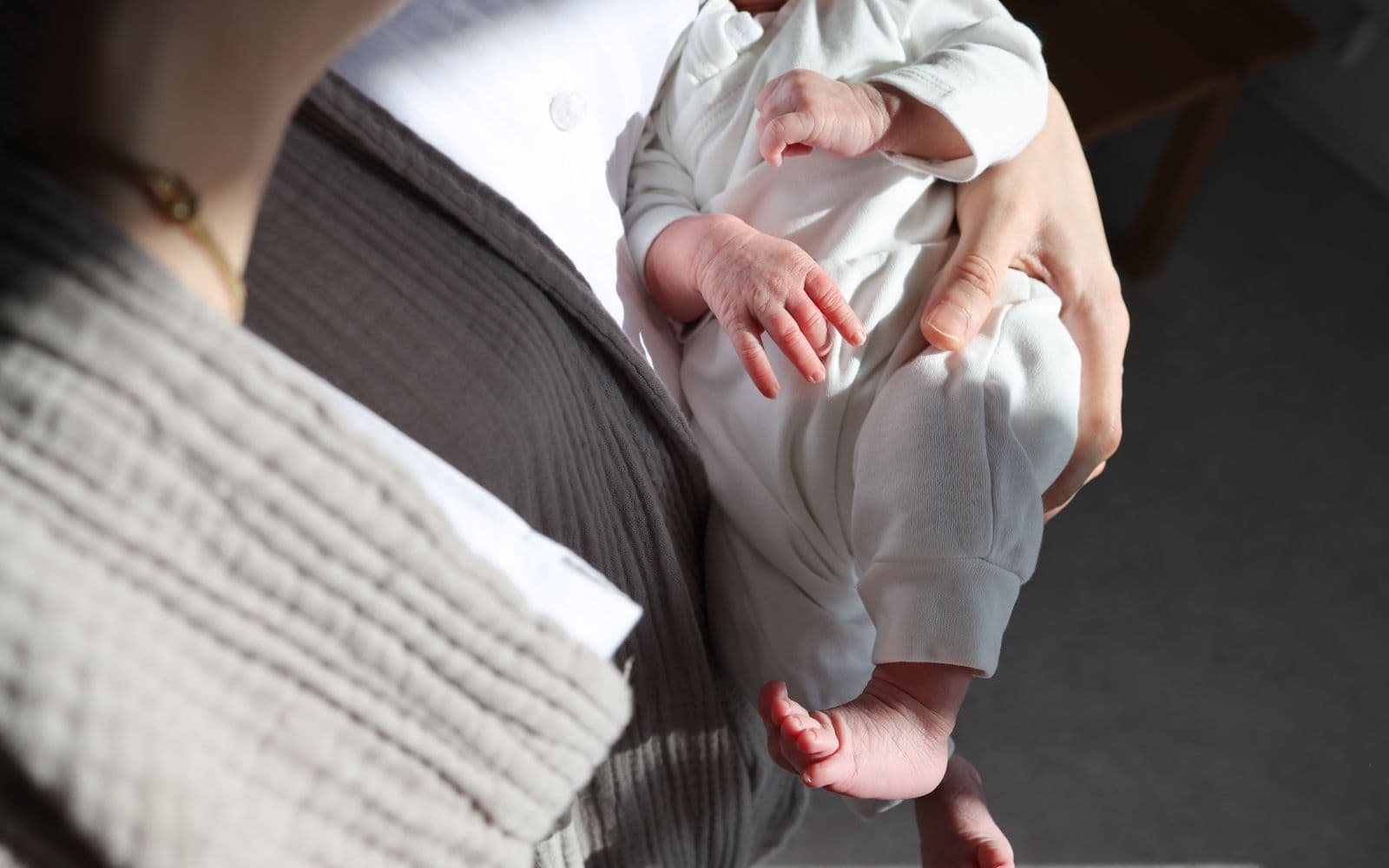
Your first-month command center
Before you leave the hospital, birth centre, or midwife
Don’t assume the hospital, birth centre, or midwife has completed all the government paperwork. Usually health providers complete the medical birth documentation, but parents still need to complete the civil birth registration with the province. Before you go home, ask one plain question: what exactly has already been done, and what do I still need to do?
Confirm before you go home
- Has the medical notice / statement of live birth been sent — and do I need a paper form or an online registration code?
- Has the newborn blood-spot screening and the hearing screening been done or scheduled?
- Has jaundice follow-up been recommended? Was vitamin K given, and eye prophylaxis discussed?
- Do we have a follow-up appointment in the recommended window, and who do we call about feeding, weight, jaundice, fever, or breathing?
Register the birth
Birth registration is the foundation document — everything else stands on it wearing tiny booties. You must register with the province or territory where the baby was born; if that differs from where you live, contact the vital statistics office where the birth took place. Registration creates the permanent legal record. It is not the same as ordering a birth certificate: registration makes the record, the certificate is the document you order from it. Pick your jurisdiction to see what bundles together where you are.
Information you may need
- Baby’s full legal name, date, time, and place of birth.
- Parents’ legal names, dates and places of birth, and addresses.
- Parents’ SINs (if applying for child benefits) and health numbers (if health enrolment is bundled).
- Hospital, birth centre, midwife, or attendant details — and a payment card if ordering a certificate.
Order the birth certificate
For a newborn, the safest default is usually the birth certificate with parental information — the version that includes the child’s and the parents’ details. Ontario recommends this version for children under 16 when parental information is required, and notes it can be used for a child’s passport, child health insurance, Indian Status, and some immigration or citizenship applications. Order the short version and later need the long one, and you may have to order again.
| Use | Why the long form matters |
|---|---|
| Child passport | Passport Canada accepts a long-form birth certificate as proof of Canadian citizenship, plus proof of parentage. |
| Health card issues | Resolving enrolment or identity questions for the baby. |
| School & travel | Proof of identity and parentage as the child grows. |
| Immigration / status | Citizenship, status card, or active immigration applications. |
Apply for baby’s Social Insurance Number
A baby needs a SIN for many savings and benefit programs — especially RESPs, the Canada Learning Bond, and Canada Education Savings Grants. Service Canada says that if a child is under one and the birth isn’t yet registered, you can apply for the SIN through the province’s Newborn Registration Service. That service is in all provinces but not yet in the territories — parents in a territory apply directly through Service Canada. There’s no fee.
Apply for the Canada Child Benefit
The Canada Child Benefit (CCB) is a tax-free monthly payment for eligible families raising children under 18, administered by the CRA. You may be eligible if you live with and are primarily responsible for the child, are a resident of Canada for tax purposes, and meet the status requirements (citizen, PR, protected person, eligible temporary resident, or registered under the Indian Act). Eligible temporary residents generally need 18 months in Canada and a valid permit in the 19th month.
| Route | When to use it |
|---|---|
| Automated Benefits Application | Easiest where available — apply during birth registration; consent to share with CRA, enter your SIN, submit. Not available in Nunavut. |
| CRA account | If you didn’t apply during birth registration. |
| Form RC66 by mail | Also registers the child for the GST/HST credit & related programs. |
Register for health coverage
Your baby needs provincial or territorial health coverage, and how it works depends heavily on where you are. In Ontario, a baby born in hospital or with a registered midwife is enrolled via the Health Coverage Infant Registration form — you keep the bottom section (with the baby’s health number) until the card arrives within ~8 weeks. In B.C., if the birth parent has MSP, the electronic birth registration sends the baby’s info to Health Insurance BC. Don’t borrow another province’s rules — that’s how paperwork sprouts legs.
- Does baby already have a temporary health number, and will the card be mailed automatically?
- Do I need to submit a separate health-coverage application — and what if my own coverage is pending?
- What if we’re uninsured, a refugee claimant, a visitor, a student, or on a work permit?
- What if baby was born at home, in another province, or needs medication or specialist care before the card arrives?
Screening & the first appointment
Newborn blood-spot screening is completed between 1 and 7 days of age, ideally days 2–3; if done before 24 hours, it should be repeated within 5 days. Ontario and B.C. describe collection around 24–48 hours after birth; Quebec also takes a urine sample at 3 weeks for certain hereditary conditions. Ask whether blood-spot and hearing screening were done, whether anything is pending, and what phone number to answer if they call.
The first newborn appointment isn’t ceremonial — it’s where someone checks the things tired parents judge with one eye open: weight, feeding, jaundice, hydration, sleepiness, diaper output, cord healing, and latch. PHAC guidance says follow-up should be scheduled 24–72 hours after discharge (within 24–48 hours for late-preterm babies, arranged before going home). The widely used Rourke Baby Record includes visits at 1 week, 2 weeks, and 1 month.
- Baby’s discharge papers & health number.
- Feeding log and diaper count, if you have them.
- Any jaundice or screening instructions.
- Vitamin D drops and a list of questions.
- Is weight loss or gain on track?
- Are the wet and dirty diapers enough?
- Is jaundice a concern — do we need a bilirubin test?
- Do we need vitamin D, and when’s the next visit?
The “call now” signs & safe sleep
For emergency symptoms, call 911 or go to emergency. For non-emergency advice, many provinces have 24/7 nurse lines at 8-1-1. The big one for newborns is fever: Caring for Kids says babies under 6 months with a fever should see a doctor, and babies under 3 months should be seen urgently. Call your provider or 811 if your baby won’t wake to feed, is always sleepy, won’t feed, or isn’t having the expected wet and dirty diapers (by day 6–7, at least 6 large, heavy wet diapers a day).
Safe sleep, from day one
- back to sleepPlace baby on their back for every sleep, on a firm, flat surface with no loose or soft bedding.
- own spaceUse a crib, cradle, or bassinet — no pillows, loose blankets, bumpers, toys, nests, pods, or wedges. Drop-side cribs are illegal to sell or give away in Canada.
- room-shareKeep baby’s sleep space in the parent/caregiver room for the first 6 months. No smoke or vaping around baby.
- move themIf baby falls asleep in a car seat, swing, bouncer, or carrier, move them to a safe sleep space when you can. Never on couches, armchairs, or adult beds.
Private benefits & life admin
Government paperwork is only one side; the private paperwork goblin has its own tiny clipboard — and many plans have deadlines to add a dependent after birth. Within the first 30 days, check both parents’ workplace benefits, any union, student, or private health/dental/drug plan, life-insurance beneficiaries, disability or critical-illness coverage, and pension or group-plan forms.
- How long do I have to add my baby?
- What proof works before the birth certificate arrives?
- Can I use a hospital record or temporary health number?
- Is baby covered under both parents’ plans — which pays first?
- CRA marital status (if it changed), address & direct deposit.
- EI maternity/parental claim if the actual birth date differs.
- Employer top-up documents & provincial benefit accounts.
- Immigration or sponsorship file, if relevant.
For newcomer parents & passports
If your baby is born in Canada, the child is likely a Canadian citizen, and a provincial or territorial birth certificate is valid proof of that (with narrow exceptions, like a parent with diplomatic privileges). But a baby’s citizenship doesn’t give the parents PR, citizenship, health coverage, or benefit eligibility — your own situation still decides your CCB, healthcare, and immigration standing. Confirm baby’s registration, long-form certificate, and health eligibility separately from your own status.
Start the baby document folder
Create one secure place for baby’s records — a physical folder, a cloud folder, a password-manager note, whatever fits your household. The point isn’t perfection; it’s not hunting for a SIN confirmation under a nursing pillow in 2029.
- Birth registration confirmation & certificate.
- SIN confirmation; CCB confirmation & CRA notice.
- Health card / number; hospital discharge papers.
- Screening results, immunization record, insurance confirmations.
- Midwife, family doctor, paediatrician, public-health nurse.
- Lactation consultant; 811; local urgent care & nearest ER.
- CRA, Service Canada, vital statistics office.
- Private insurer and HR / payroll.
Common mistakes
- 01 · the hospital did itThinking the hospital registered the birth. They submit medical birth info; parents still complete the civil registration with the province.
- 02 · wrong certificateOrdering the short certificate. For a child, the version with parental information is usually more useful — including for a passport.
- 03 · income too highSkipping the CCB because you assume you earn too much. Apply if you may be eligible; the CRA calculates the amount from your family net income.
- 04 · status confusionForgetting CCB depends on the parent’s status and residency, not the baby’s citizenship.
- 05 · benefits deadlineWaiting too long to add baby to private benefits. Check the employer or insurer deadline in the first week.
- 06 · no card, no careAssuming baby can’t get care without the physical health card. Ask how care works while the card is pending — many provinces issue a temporary number.
- 07 · unknown numbersNot answering unknown phone numbers after screening. Programs, public health, and clinics may call from numbers you don’t recognize.
- 08 · no notesNot writing down feeding and diaper concerns. A few notes help the provider see the pattern — no elaborate tracker required.
The day-by-day first-month plan
Before & after discharge
- 01Confirm baby’s & parent’s discharge plans and the first follow-up appointment
- 02Confirm newborn & hearing screening status and ask about jaundice follow-up
- 03Ask about vitamin D if breastfeeding Health Canada recommends 400 IU (10 µg) daily for breastfed infants
- 04Save all discharge papers and note who to call after hours
The first week
- 01Attend the baby follow-up appointment and parent follow-up if needed
- 02Register the birth and apply for CCB + the SIN during registration if available
- 03Order the long-form birth certificate and confirm the health-card process
- 04Start the document folder & add baby to benefits watch the dependent-add deadline
Confirm & follow up
- 01Check birth registration, CCB & SIN confirmations and health-card status
- 02Confirm any repeat newborn or hearing screening and the next baby appointment
- 03Watch for birth-certificate delivery in Quebec, confirm the 3-week urine screening
- 04If travelling, start passport planning order the long-form certificate early
Close the loop
- 01Confirm the one-month or next well-baby visit and that baby has a health number
- 02Make sure CCB is submitted and the SIN requested and the certificate ordered
- 03Check insurance coverage and start RESP planning if ready
- 04Book or note the 2-month immunizations call public health or 811 to schedule
Baby’s first 30 days checklist
The whole first month on one page. Everything you tick or type is saved on this device, and the print button gives you a clean copy for the fridge, a partner, or a grandparent on duty. The point isn’t perfection — it’s never hunting for a confirmation number under a nursing pillow again.
Official sources & the final takeaway
Register the birth where the baby was born; order the long-form certificate; apply for the SIN and the CCB — ideally bundled through newborn registration; enrol baby for health coverage; book the follow-up and confirm screening; add baby to private benefits before the deadline; and keep one folder for it all. The first month is soup, but the paperwork dragon behaves when you feed it confirmations.
Official resource box
The Government of Canada hub for birth registration, certificates, the SIN, health cards, and benefits.
SourceApply through the provincial Newborn Registration Service, or directly with Service Canada in a territory. No fee.
SourceEligibility, the Automated Benefits Application, RC66, who should apply, and the ~8-week timeline.
SourceRegister the birth and order the certificate together; the bundle can include the SIN and CCB.
SourceOnline birth registration can apply for the CCB, a SIN, and MSP enrolment for eligible families.
SourceOnline registration can apply for the CCB and a SIN and order a birth certificate ($40 each).
SourceFile the declaration of birth with the Directeur de l’état civil within 30 days, with the attestation of birth.
SourceDischarge follow-up plans, screening timing, and newborn care recommendations.
SourceBack to sleep, firm flat surface, no soft bedding, and room-sharing for the first 6 months.
SourceProof of citizenship, parentage, and custody for a child 15 and under; the long-form certificate works.
Source- Government of Canada — Birth — Registration, certificates, SIN, health cards (Reviewed Jun 2026)
- Service Canada — SIN — Newborn Registration Service & direct applications (Reviewed Jun 2026)
- CRA — Canada Child Benefit — Eligibility, ABA, RC66, who applies (Reviewed Jun 2026)
- Provincial vital statistics — Ontario, BC, Alberta & Quebec examples (Reviewed Jun 2026)
- PHAC & Caring for Kids — Newborn care, screening, follow-up, fever (Reviewed Jun 2026)
- Health Canada & IRCC — Safe sleep, vitamin D, citizenship & passports (Reviewed Jun 2026)
Comments