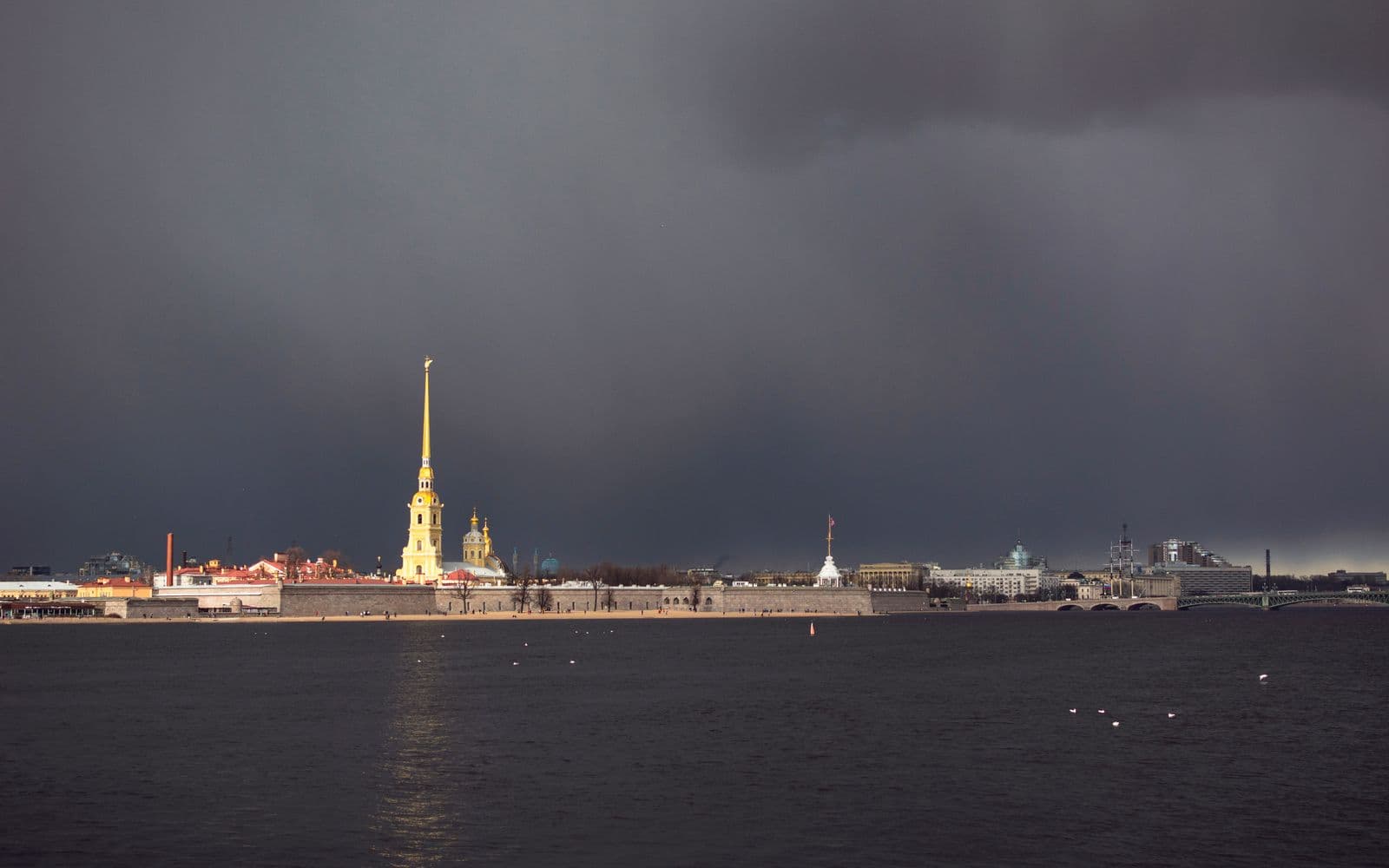
The Eagle is born from a broken crown. The Bear wakes in a forest of burned kingdoms.
Cold Open
Begin with two sounds.
The first is paper. A quill scratching across parchment in a hot Philadelphia room in the summer of 1776, while flies circle the candles and men who could be hanged for treason argue over a single word. Outside, the war is already killing people. Inside, they are writing a sentence about liberty that they cannot yet live up to.
The second sound is hooves in snow. Six centuries of them. Riders coming out of the east, out of the steppe, toward wooden cities that will not survive the winter. Church bells cracking in the cold. A prince kneeling in the mud before a stranger who now owns his life.
One nation will be born from the paper.
The other will be forged by the hooves.
They are not enemies yet. They are barely aware of each other — two shapes at the far edges of each other’s maps, one staring west across an ocean, the other staring in every direction at once because in every direction there has always been an army. Before the spies, before the missiles sleeping under the sea, before the whole world learned to whisper the words Cold War, there were only two storms, forming far apart, in completely different weather.
This is the story of how the weather made them.
Not with hatred. With origins. With two maps growing toward each other from opposite ends of the earth — and neither one knowing that the other exists.
The Eagle Before It Had Wings
The United States does not begin as a country. It begins as an argument between an empire and its own children.
Before America called itself America, it was a thin line of British settlements facing the Atlantic — thirteen colonies that were not one people, one economy, or one idea. Massachusetts was not Virginia. Pennsylvania was not South Carolina. Some colonies lived on trade, some on plantation slavery, some on religious experiments, some on the raw violence of the frontier. They were founded on Indigenous land, tied to European markets, and built by an extraordinary mix of merchants, farmers, dissenters, debtors, soldiers, and enslaved Africans dragged across the ocean against their will.
What united them was distance.
The Atlantic was not only water. It was a political furnace. Orders from London arrived late. Taxes felt colder three thousand miles from the king who imposed them. And so the colonists learned to govern themselves in local assemblies, to argue in their own newspapers, to drill in their own militias — and slowly to think of themselves as people whose lives were shaped not only by Parliament, but by their own hands.
They were British subjects. Then, through a decade of war debts, new taxes, boycotts, riots, soldiers in the streets, and pamphlets that spread like fire, enough of them stopped feeling like subjects at all. Britain looked across the ocean and saw rebellion. The colonists looked back and saw tyranny.
In 1776, the argument became a declaration.
On July 4, 1776, the Second Continental Congress adopted the Declaration of Independence, formally severing the thirteen colonies from British rule; the engrossed parchment was later signed by delegates beginning on August 2[1]. That date — July 4 — became America’s chosen birthday. But birthdays can be mythic things. They can shine so brightly they hide the blood on the floor.
The Declaration spoke in thunder. It claimed that all men are created equal, that governments derive their just powers from the consent of the governed, and that the people have the right to alter or abolish any government that becomes destructive of those ends[1]. These are among the most quoted political sentences ever written. And they were written inside a society built in significant part on slavery: at the first national census of 1790, about 700,000 of some 3.9 million people — close to one in five — were held in bondage[2]. That is the central paradox of the American Revolution: a fight for liberty waged in a world of slavery.
That contradiction is not a footnote. It is part of the storm.
America was born with a golden promise in one hand and an iron chain in the other. It declared liberty while hundreds of thousands remained enslaved. It spoke of unalienable rights while Native nations fought to keep their homelands, forced by the war to gamble their survival on one empire or another.
So the Eagle’s birth was not pure. No nation’s is. But it was powerful — because it handed America a myth it would carry forever: we are the people who broke a crown. That single idea would become the nation’s pride, its shield, its weapon, and its favorite disguise. The Eagle did not imagine itself as an empire. It imagined itself as an escape from empire — and later, when it grew powerful enough to act like one, it would still speak the language of liberation. It would expand and call it freedom. It would intervene and call it self-government.
The first storm had already learned its favorite spell: power, dressed as liberty.
A Crown Breaks, a Republic Rises
Winning the war did not create a nation. It created a second, harder question: how do thirteen former colonies become one country without building the very tyranny they just bled to escape?
The new republic feared everything at once. It feared kings and it feared mobs. It feared standing armies and it feared weakness. It feared distant power and it feared having no power at all. That is a very difficult way to build a house.
Its first attempt nearly collapsed. Under the Articles of Confederation, the central government was deliberately kept weak — no power to tax, no power to compel the states — and the young country staggered under debt, foreign pressure, and internal revolt[3]. Independence, it turned out, was not the same thing as government.
So in the summer of 1787, delegates gathered in Philadelphia, officially to revise the Articles. Instead, behind closed windows, they built something new. The Constitution of the United States — a four-page document establishing the framework of the federal government — was signed on September 17, 1787, the product of months of debate, redrafting, and hard compromise[4].
This is where the Eagle’s skeleton formed. A president, but not a king. A Congress, but not the British Parliament. A Supreme Court that would one day grow strong enough to overrule them both. The Constitution did not end conflict; it organized conflict, building disagreement directly into the machinery. That was its genius. It was also its danger — because every argument they could not resolve was sealed inside the walls: slavery, representation, states’ rights, citizenship, and the meaning of that small, explosive phrase, the people.
America was not born as a finished answer. It was born as a question with borders: can a republic survive its own power? That question would follow the Eagle across a continent, into civil war, into two world wars — and straight into its collision with the Bear.
The Bear Before It Had a Name
Russia has no July 4. No single room, no signed page, no clean morning when a new nation was declared alive. Russia’s beginning is not one door opening. It is a long corridor of doors, and to walk it honestly we must start long before “Russia” existed at all.
We start with Rus’ — a medieval world of rivers, forts, princes, monks, and traders. Kievan Rus’ (also written Kyivan Rus’) was an East Slavic federation of principalities centered on Kyiv, ruled by the Rurikid dynasty from roughly the ninth century until 1240, and it stands as a formative early stage in the histories of modern Russia, Ukraine, and Belarus[5].
That last part matters enormously. This inheritance belongs to more than one nation. It cannot be flattened into “Russia began in Kyiv,” as if Ukraine and Belarus were footnotes. The memory of Rus’ is shared, contested, remembered differently in each country — and politically explosive to this day. But as one of the deep roots of the Russian state, Rus’ cannot be skipped.
In that world, the rivers were everything — the Dnieper, the Volga, the great trade road remembered as the route “from the Varangians to the Greeks,” linking the Baltic to the Black Sea. Down those rivers moved furs, wax, honey, silver, enslaved people, weapons, icons, and gods. This was not a sealed forest kingdom; it was a crossroads, looking north to Scandinavia, south to the wealth and faith of Byzantium.
Then came the choice that shaped everything after. Around the year 988, Grand Prince Vladimir of Kyiv adopted Christianity and had the people of the city baptized in the Dnieper, binding Rus’ to the Orthodox Christian world of Byzantium rather than the Latin West[6]. That single decision braided politics to sacred authority. It brought literacy, law, icons, and a powerful new idea: that a ruler’s power was not only military — it was holy.
The Bear was not yet Russia. But something was breathing in the forest — not one kingdom with one destiny, but a scatter of rival cities, sacred images, winter roads, and wooden walls.
Then the riders came.
Fire From the Steppe
In the thirteenth century, the Mongols shattered the world of Rus’.
The house was already cracking before the storm hit — the principalities had fractured into rival princes who fought one another more readily than any outside foe. Then the Mongol armies arrived: fast, disciplined, terrifying masters of siege and psychological warfare. Between 1237 and 1240 they stormed and burned the great cities one by one, and in December 1240 Kyiv itself fell — the event historians treat as the end of Kievan Rus’[7].
Do not imagine a single heroic battle. Imagine the real sound of a civilization collapsing: wooden walls burning, church bells breaking, princes fleeing or kneeling, families vanishing into smoke, messengers riding through the snow with news no one wanted to hear. The scale still stuns. By one account, of roughly 50,000 people in Kyiv before the siege only about 2,000 survived, and just six of some forty major buildings were left standing[7].
And the Mongols did not simply pass through. The surviving principalities were absorbed into the western wing of the Mongol Empire — the state remembered as the Golden Horde — under which Russian princes had to travel to the khan to receive a patent to rule, and to send tribute outward for generations[7]. Survival now required calculation, submission, patience, and sometimes collaboration with the very power that had burned your city.
We should be careful here. It is too easy to say “the Mongols made Russia autocratic,” as if one cause could explain three centuries. History is not a vending machine. But it is fair to say the Mongol period left deep marks — on tribute systems, on military organization, on diplomacy, and on the brutal education of surviving beneath an overwhelming power.
And out of that shattered world, an unlikely town began to rise: Moscow. As Mongol dominance slowly declined across northern Eurasia, one small principality gathered land, tribute rights, and church prestige until it became the core of an intensely centralized state with its own imperial ambitions[8].
The Bear was waking. Not gently. It woke under pressure, among ashes, and it learned lessons it would never forget: that open plains invite invaders, that weakness invites tribute, that distance can be a weapon, and that power must be gathered before your enemies gather it for you.
Here lies the deepest difference between the two origin stories. America’s founding myth says: we broke free from a king. Russia’s older memory says: we survived the horsemen, the fires, and the tribute collectors.
One is a myth of rebellion. The other is a myth of endurance.
One fears tyranny from above. The other fears collapse from without. Both fears are completely real. Both can become dangerous.
Muscovy: The Forest Learns to Rule
The rise of Moscow was no fairy tale. It was slow, opportunistic, and often ruthless. Moscow gathered — land, princes, tribute, church authority, symbols, and memory.
By the late 1400s, Ivan III — Ivan the Great — had thrown off the last of Mongol overlordship and vastly expanded Moscow’s domains, forging the core of a centralized Russian state[8]. Then, in 1547, his grandson Ivan IV — Ivan the Terrible — was crowned tsar at the age of sixteen, the first Russian ruler formally to take the title, proclaiming the Tsardom of Russia[10].
The word carried weight. Tsar descends from Caesar. It claimed imperial, sacred, supreme authority — a ruler standing above ordinary princes. And after Constantinople, the last capital of the Orthodox Roman world, fell to the Ottomans in 1453, a breathtaking idea took root in Moscow: that Moscow itself might be the heir of Christian empire — the “Third Rome,” the final defender of the true faith[9].
This was not merely politics. It was cosmic theater. The ruler was not just a ruler; the capital was not just a city; the state was destiny wearing a crown. And destiny has teeth. Russian power spread across forest, steppe, and eventually all of Siberia, absorbing peoples, faiths, and languages, fighting khanates, Poland-Lithuania, Sweden, and the Ottomans — looking west with envy and suspicion, south with hunger for warm-water ports, and inward with a constant fear of revolt.
Notice the mirror already forming. America would expand across a continent and tell itself expansion meant freedom and destiny. Russia would expand across Eurasia and tell itself expansion meant depth and survival. Both stories justified conquest. Both built empires that denied being empires. The Eagle flew west toward promise; the Bear pushed outward in every direction searching for buffers and safety. Neither was innocent. Neither was simple.
Peter’s Window and the Empire of Snow
Then came a ruler who seems half-historical, half-forged from iron.
Peter the Great wanted ships, sciences, and armies drilled in the European style. He wanted Russia to stop being treated as the backward edge of Europe and become a great power at its center. In 1703 he founded a brand-new capital on conquered marshland facing the West and named it Saint Petersburg — a deliberate “window on Europe,” raised by conscripted labor at a cost so severe it is often called “the city built on bones,” with construction deaths traditionally numbered in the tens of thousands[11]. Then he took on the strongest military power in the north.
After more than two decades of the Great Northern War, Russia broke Sweden’s dominance; the Treaty of Nystad in 1721 confirmed Russia’s conquests on the Baltic, and that same year Peter proclaimed the Russian Empire, taking the title of Emperor[12]. The Bear was no longer merely waking. It was dressing itself in imperial clothes — learning to wear a European coat without ever forgetting the forest.
That double identity would haunt Russia for centuries. Was it European or Asian? Should it imitate the West or resist it? Should it modernize by force, or protect tradition by force? These were never just questions for books. They became wars, reforms, purges, and revolutions. Unlike America, Russia was not born by rejecting monarchy. It was built through monarchy — through tsars, centralization, and the iron conviction that if the center did not hold, the land would be devoured from every side.
This does not mean Russians only ever obeyed. Russia also produced rebels, radicals, reformers, poets, and revolutionaries who stared power in the face and refused to blink. But the state tradition was heavy, and the crown was not easily broken. When it finally did break — in the revolution of 1917 — the explosion would remake the world and set the stage for everything the Eagle and the Bear would become to each other[13]. That is a later episode. For now, the Bear is still growing.
Geography, Memory, and Fear
Now set the two stories side by side and look beneath them, because the real forces here are not villains and heroes. They are geography, memory, and fear.
America’s hidden pressure was space as safety. Two oceans stood between the young republic and every great army on earth. A weak neighbor to the north, a weaker one to the south, and an open continent to the west. That geography let America believe something no European state could afford to believe: that freedom itself could be the source of security — that you could keep the government small, the army smaller, and still survive. American power grew outward from optimism. Every horizon looked like promise.
Russia’s hidden pressure was the exact opposite: space as danger. The same flat land that carried its trade carried its invaders — the Mongols out of the east, and later the Swedes, the Poles, and worse still to come. Russia had no ocean moat, no natural wall. Its answer to vulnerability was depth: become so vast, so centralized, so heavily defended that no enemy could ever swallow you whole. Russian power grew outward from fear. Every horizon looked like a road down which an army might come.
From these two pressures flow two entire political souls.
America worships the citizen and fears concentrated power, because its founding wound was a distant king who taxed without consent. So it built a system designed to divide power — and to this day it reads centralized authority as the primary nightmare.
Russia fears chaos and the broken center, because its founding wounds were invasion and collapse — the burning of Kyiv, the tribute to the khan, the times when weakness meant annihilation. So it built a system designed to concentrate power — and to this day it reads instability, encirclement, and the loss of buffer states as the primary nightmare.
One says: liberty is safety. The other says: strength is safety.
Here is the trap that will one day become the Cold War. When America eventually looks at Russia, it will see tyranny, secret police, censorship, and the crushing of the individual. When Russia eventually looks at America, it will see arrogance, hypocrisy, and a power that preaches freedom while ringing others with bases, money, and alliances. Both will be partly right. Both will be partly blind. Because a nation rarely fears another only for what it is. It fears what the other reveals — the nightmare hiding inside its own founding story. America will see in Russia the horror of the all-powerful state. Russia will see in America the horror of destabilizing freedom dressed up as friendship.
And when a nation lives by imagination, it can become reckless. When a nation lives by memory, it can become paranoid. That is the beginning of the storm — not in any single decision, but in the shape of two fears that fit together like a lock and a key.
Tell It the Mythic Way
Now tell it the true way — the mythic way. There are two births.
The first happens beside the sea. A crown cracks above thirteen colonies, and from the crack falls a single burning spark. From the spark rises an Eagle — wet-winged, furious, impossibly young, the taste of royal iron still in its beak. Around its nest stand farmers and printers and lawyers arguing by candlelight, and beside them stand enslaved people and Native nations and widows and sailors, all of them inside the same story whether the Eagle names them or not. The Eagle opens its throat and screams one word across the water.
Liberty.
It believes the word completely. It does not yet see the bones beneath its own nest — the ones it has not learned to name.
The second birth happens far inland, and there is no crown to break. There is only a forest, and the forest has burned before, and it knows it will burn again. Cities smoke in the snow. Church bells lie cracked in black mud. Princes kneel before distant riders. Mothers teach their children the oldest lesson in the world: listen for hooves. And beneath the frozen roots, something enormous stirs and opens a single eye.
The Bear does not scream liberty.
The Bear asks one question, low and patient: who is coming next?
That question becomes its heartbeat. The Bear does not grow because it loves being large. It grows because every clearing looks like a wound waiting to happen, every border looks temporary, every neighbor might become a road for an army. The Eagle grows because every horizon is a promise. The Bear grows because every horizon is a threat.
The Eagle dreams of open sky.
The Bear dreams of deep earth.
And they cannot see each other yet — an ocean and a continent and centuries lie between them. But far away, in the space between the two births, history quietly begins to sharpen its knives. Because the truth beneath the beauty is not that one storm was good and the other evil. That is easy history, and easy history is only propaganda in a clean shirt. The truth is that both were built from the same contradiction. America spoke of liberty while holding people in chains. Russia spoke of holy order while crushing its own. America feared empire while conquering a continent. Russia feared invasion while conquering its neighbors. Both turned geography into destiny. Both became magnificent. Both became dangerous. And both, one day, would look across a shrinking world and see, staring back, not a stranger — but a monster wearing their own opposite face.
For now, there are only two storms. One over the Atlantic. One over the snow. And between them, history waits.
The Question Left Behind
Two nations grew from opposite weather — one taught by a broken crown that freedom is safety, the other taught by a burned forest that only strength is safety. Each became convinced its own fear was wisdom, and the other’s fear was a mask for something monstrous.
So here is the question that will haunt every episode still to come:
When the day finally arrives that the Eagle and the Bear look across the same narrow world — will they be staring at an enemy, or at the one truth each spent its whole history refusing to see in itself?
National Archives, “Declaration of Independence (1776),” Milestone Documents. archives.gov ↗
The Gilder Lehrman Institute of American History, “The First National Census: Records of a Growing Nation, 1790 to 1800.” gilderlehrman.org ↗
National Archives, “The Constitution: How Did it Happen?,” America’s Founding Documents. archives.gov ↗
National Archives, “Constitution of the United States (1787),” Milestone Documents. archives.gov ↗
World History Encyclopedia, “Kievan Rus.” worldhistory.org ↗
EBSCO Research Starters, “Baptism of Vladimir I.” ebsco.com ↗
Wikipedia, “Siege of Kiev (1240)” and “Mongol invasion of Kievan Rus’.” Siege of Kiev ↗ · Mongol invasion ↗
Encyclopaedia Britannica, “Rurik Dynasty.” britannica.com ↗
Wikipedia, “Tsardom of Russia.” wikipedia.org ↗
Encyclopaedia Britannica, “Ivan IV (Ivan the Terrible), summary.” britannica.com ↗
Wikipedia, “History of Saint Petersburg.” wikipedia.org ↗
Wikipedia, “Treaty of Nystad” and “Peter the Great.” Treaty of Nystad ↗ · Peter the Great ↗
U.S. Department of State, Office of the Historian, “Recognition of the Soviet Union, 1933,” Milestones. history.state.gov ↗
Comments