You were diagnosed into the best moment in history
I want to tell you, as plainly as I can: the world you've been diagnosed into is not the world your uncle was diagnosed into. Twenty-five years ago, AS treatment was essentially painkillers and stoicism. Today there are at least ten different medications with proven efficacy, each with a different mechanism, side-effect profile, and place in your journey. Half of the most important were approved after 2015. Bimekizumab — possibly the most effective single agent — was approved for AS in 2024.
This article is the map. By the end you should be able to walk into any rheumatologist's office and have an informed, two-way conversation about your treatment — not just receive instructions. Let's go.
Where we were, where we are
For about a hundred years, AS treatment was three things: aspirin (then NSAIDs once they existed), physiotherapy, and surgery for the worst spinal deformities. Patients fused. Patients lost height. Patients couldn't lift their gaze to see the sky in front of them. There was no good answer.
- 2003 · TNFThe first TNF-alpha inhibitor reached AS (infliximab, etanercept). For the first time you could meaningfully stop the inflammation, not just dampen it. Rheumatologists describe their careers in two acts: before biologics and after.
- 2015 · IL-17The first interleukin-17 inhibitor, secukinumab — an entirely different mechanism. Patients who had failed TNF blockers suddenly had another door.
- 2019–22 · JAKJAK inhibitors arrived: small-molecule pills, no injections, hitting another pathway again.
- 2024 · dual IL-17Bimekizumab — the first agent to block both IL-17A and IL-17F at once — was approved for AS in the US, with the highest single-agent response rates yet seen.
You are being diagnosed at the best moment in human history to have ankylosing spondylitis. That sentence is not a consolation — it is a statement of fact.
The treatment pyramid
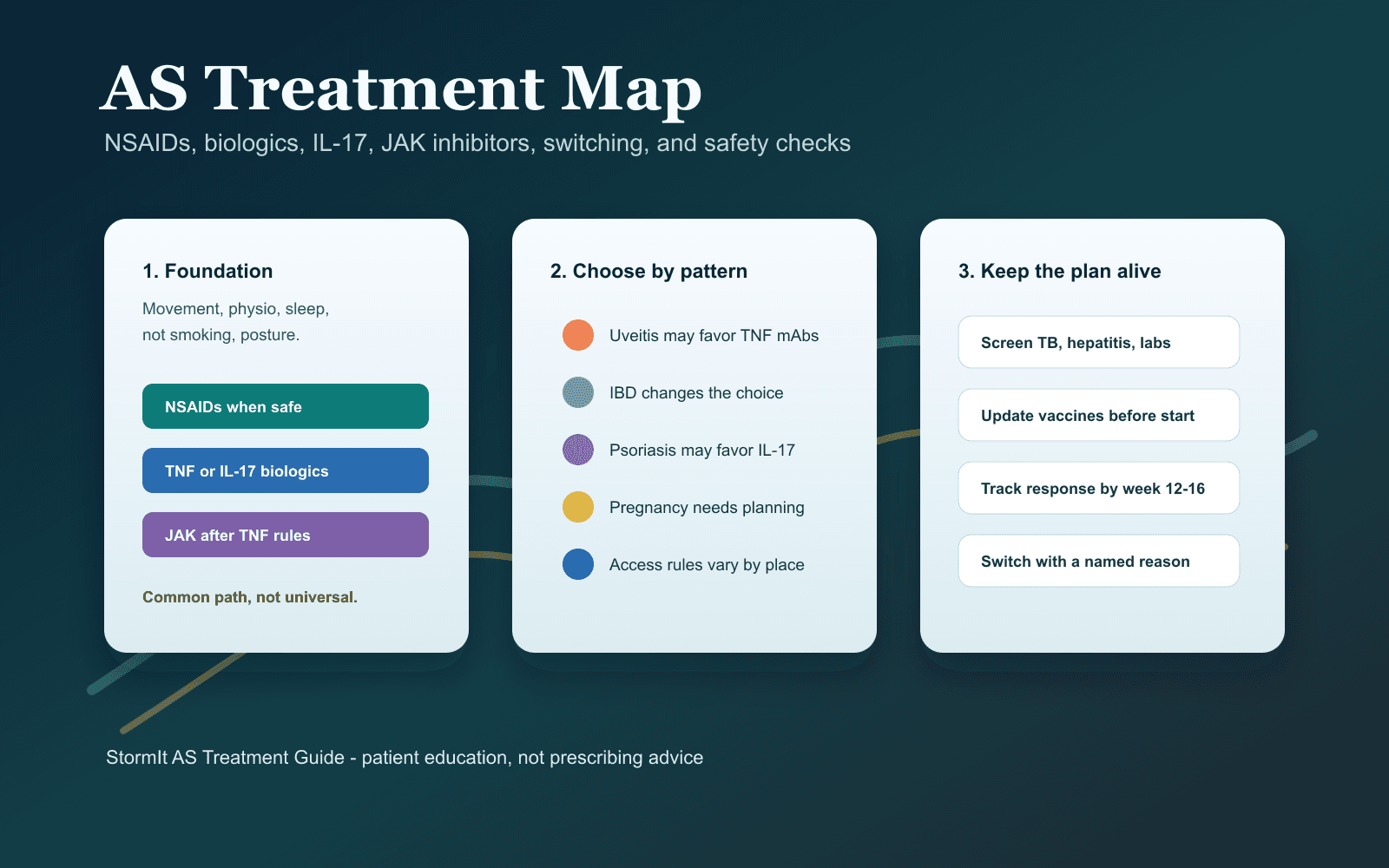
Every guideline — ACR/SAA/SPARTAN in the US, ASAS-EULAR in Europe — recommends a stepped approach. You climb only as high as you need to. Most patients don't need every level.
Drug by drug
Let's go through every class. For each: what it is, how it works, who it's for, what it does well, what it doesn't, and what to watch for.
NSAIDs
The familiar painkillers at AS-appropriate doses — naproxen, ibuprofen, celecoxib, diclofenac, etoricoxib, meloxicam. They block COX enzymes, reducing prostaglandin-driven inflammation. Guidelines require a trial of at least two different NSAIDs at maximum tolerated dose, each for 2–4 weeks, before stepping up to biologics.
- Genuinely effective — about 60–70% of AS patients get meaningful symptom relief
- Cheap, available everywhere, well understood
- Continuous (vs on-demand) use may slow radiographic progression — though this is still debated
- GI side effects — ulcers, bleeding (lower with COX-2 selective like celecoxib)
- Cardiovascular risk with high-dose long-term use; kidney decline over years
- They manage symptoms — they do not stop the underlying disease
Conventional DMARDs
The older immunosuppressants — sulfasalazine and methotrexate. The honest reality: they do not work for axial (spinal) AS. Period. Multiple trials have shown this. They retain a small role only for patients whose AS also involves peripheral joints (knees, ankles, wrists) — and even there they are being eclipsed by biologics.
TNF inhibitors
Five approved agents, all targeting tumor necrosis factor alpha — a master cytokine of inflammation — by binding it directly or acting as a decoy receptor. With TNF neutralized, downstream inflammation in joints and entheses falls dramatically. Usually a first biologic choice for patients who've failed two NSAIDs with active disease (BASDAI ≥4).
| Drug (brand) | Route | Frequency | AS since |
|---|---|---|---|
| Adalimumab (Humira) | SC injection | Every 2 weeks | 2006 |
| Etanercept (Enbrel) | SC injection | Weekly | 2003 |
| Infliximab (Remicade) | IV infusion | Every 6–8 weeks | 2003 |
| Golimumab (Simponi) | SC injection | Monthly | 2009 |
| Certolizumab (Cimzia) | SC injection | Every 2–4 weeks | 2013 |
- Roughly 50–60% achieve ASAS40 within 12–16 weeks; many feel different in 2–6 weeks
- Twenty years of safety data — by far the longest track record of any biologic
- Effective for uveitis (monoclonals; adalimumab is standard of care) and for IBD
- Slow radiographic progression
- Increased infection risk — TB reactivation (screen everyone first), serious bacterial, hepatitis B
- Loss of response over time — 30–40% develop anti-drug antibodies (etanercept least immunogenic)
- Etanercept does NOT work for uveitis or IBD
- Contraindicated in MS, severe heart failure, active infection
IL-17 inhibitors
IL-17 is a cytokine produced by Th17 cells. In AS, IL-17A drives bone-marrow inflammation at entheses and the sacroiliac joints and feeds the remodeling that fuses the spine. Blocking it directly addresses the root pathway. Bimekizumab blocks both IL-17A and IL-17F.
| Drug (brand) | Target | Frequency | AS since |
|---|---|---|---|
| Secukinumab (Cosentyx) | IL-17A | Monthly | 2016 |
| Ixekizumab (Taltz) | IL-17A | Every 4 weeks | 2019 |
| Bimekizumab (Bimzelx) | IL-17A + F | Every 4 weeks | 2024 |
- Highest single-agent ASAS40 rates (bimekizumab ~45–48% at 16 weeks; climbs further by week 52)
- Excellent for psoriasis, often superior to TNFis
- Work after TNF failure — ~40% of TNF-refractory patients respond to bimekizumab
- Lower anti-drug-antibody rates; generally fewer serious infections than TNFis
- Can worsen or trigger IBD — IL-17 is protectively important in the gut. Usually contraindicated in Crohn's/colitis
- Candida (yeast) infections more common (bimekizumab ~10% oral thrush) — usually mild and treatable
- Less effective for uveitis than TNF monoclonals
- Newer — less long-term safety data than TNFis
JAK inhibitors
Oral pills — not injections — that block Janus kinases, the intracellular enzymes that translate many inflammatory signals into action. Broader strokes, in pill form. Per current US labeling, used after failure of at least one TNF inhibitor; some European guidelines allow earlier use.
| Drug (brand) | Selectivity | Dose | AS since |
|---|---|---|---|
| Tofacitinib (Xeljanz) | Pan-JAK | 5 mg twice daily | 2021 |
| Upadacitinib (Rinvoq) | JAK1-selective | 15 mg once daily | 2022 |
- Oral — no injections, no refrigeration, no needle anxiety
- Work after biologic failure — ~45% ASAS40 at 14 weeks in bDMARD-refractory patients (SELECT-AXIS 2)
- Sustained response through 2 years with very low radiographic progression
- Rapid onset
- FDA boxed warning: serious infections, cardiovascular events, clots (DVT/PE), malignancy
- Elevated shingles risk — get the Shingrix vaccine before starting
- Lab monitoring needed (CBC, liver enzymes, lipids)
- Usually avoided after major cardiac events or clots, and in heavy smokers over 65
The numbers
This is the chart most patients have never seen. The bars are ASAS40 response rates — the proportion of patients achieving at least a 40% improvement across multiple disease-activity domains by week 14–16. ASAS40 is stringent, much harder to hit than ASAS20.
- cross-trial cautionEach drug was tested against placebo, not against each other. No head-to-head AS trial exists between these agents.
- the curve keeps risingA non-responder at week 16 isn't a non-responder forever. Bimekizumab's ASAS40 climbs to ~50% by week 52 in AS (and ~68% in nr-axSpA).
- meta-analyses agreeNetwork meta-analyses consistently rank dual IL-17A/F and IL-17A at or near the top, TNF inhibitors close behind.
- subtract the placeboPlacebo response in AS trials is meaningful (~18–22%) — partly attention, partly subjective pain measures. Always subtract it to estimate the drug-specific effect.
Real lives
These are composites — synthesized from typical pathways in the literature, not specific individuals. They illustrate the three most common journeys.
Three years of progressive low-back pain and morning stiffness. MRI showed bilateral sacroiliitis; HLA-B27 positive; CRP elevated; BASDAI 6.4.
- Month 0Diagnosed. Started naproxen 500 mg twice daily; referred to rheumatology.
- Month 3Partial relief, BASDAI still 5.2. Switched to celecoxib — no better. TB screening begun.
- Month 4Started adalimumab biosimilar, every 2 weeks.
- Week 16BASDAI 1.8. ASAS40 achieved; inflammatory markers normalized.
- Year 2Sustained remission on adalimumab plus daily exercise. Back to her life.
Takeaway · Priya represents perhaps 50% of patients — a clear NSAID trial, then a biologic, then durable response.
Diagnosed in his early thirties after years of dismissed back pain. Responded to infliximab for four years, then faded — anti-drug antibodies confirmed.
- Year 4Switched to adalimumab. Good for 18 months, then progressive loss of efficacy.
- Year 5.5Switched to secukinumab (IL-17). Mild oral thrush; BASDAI 5.6 → 2.4.
- Year 7New bloody diarrhea — Crohn's-like inflammation. Secukinumab stopped (IL-17 can worsen IBD).
- Year 8Switched to upadacitinib (JAK) — oral, covers axial AS and helps the IBD. Stable.
Takeaway · Mark represents the ~30% who cycle through multiple agents. Each switch is a planned decision, not a failure.
Misdiagnosed for over a decade as “fibromyalgia” and “degenerative back disease.” By diagnosis at 44, she already had significant spinal fusion.
- EarlyAdalimumab, then etanercept — both reduced symptoms but radiographic progression continued.
- LaterSecukinumab — better control, but ongoing limitation from existing damage.
- NowBimekizumab, with deep remission of inflammation — but fused segments cannot be reversed.
Takeaway · Sarah's case is the most important argument in this article: early diagnosis is everything. Modern drugs are extraordinary at stopping new damage. They cannot rebuild a fused spine.
The treatment journey
What does a typical AS pathway actually look like, from first symptom to good control? Here's the realistic timeline.
The most striking thing about this timeline isn't the medical steps — it's the gap between first symptoms and diagnosis, which still averages 5–8 years globally, and longer for women. Cut that gap and you change the rest of the trajectory.
— the most actionable bottleneck in the whole pathway
What's coming next
The pipeline is unusually rich right now. Here's what's actually being studied — separated into near, medium, and far horizons.
- Filgotinib (Jyseleca)A JAK1-selective inhibitor approved in Europe for AS; not currently approved in the US for AS. May offer a slightly safer profile than pan-JAK agents.
- Risankizumab (Skyrizi)An IL-23 inhibitor that missed its primary endpoint in AS — an important negative finding. IL-23 above the IL-17 step is the wrong node in axial disease, even though it works beautifully in psoriasis.
- DeucravacitinibA TYK2 inhibitor (a more selective JAK relative), already approved for psoriasis and in trials for axSpA. Could offer JAK-like efficacy with a cleaner safety profile.
- CAR-T cell therapyThe gene-engineered immune-cell technology that transformed leukemia, now showing durable remissions in lupus trials. AS will likely follow within a decade.
- Tolerogenic vaccinesInstead of blocking inflammation forever, retrain the immune system to stop attacking. Still early — but if they work, they rewrite everything.
Practical considerations
A few things every patient on these drugs should know.
- costBiologics list-price between $30,000 and $80,000 a year. Under universal healthcare most patients pay little once approved; in the US, copay programs, assistance foundations, and biosimilars cut out-of-pocket cost sharply. Always ask about biosimilars and copay cards.
- pre-treatment workupBefore any biologic or JAK inhibitor: TB screening (TST or IGRA), hepatitis B/C screening, baseline CBC and chemistry, sometimes HIV, varicella history, and pregnancy testing for women of reproductive age.
- when to switchPrimary non-response (no improvement by week 12–16) → switch class. Secondary loss of response → often antibodies; switch within or between classes. Intolerance → switch drug. New comorbidity (IBD on IL-17, MS on TNFi) → switch class urgently.
- pregnancyCertolizumab pegol is the preferred biologic in pregnancy (minimal placental transfer). Most TNFis can continue into the second trimester; IL-17 inhibitors are usually held; JAK inhibitors are contraindicated. AS itself does not impair fertility.
Vaccinations
- Influenza — annually
- COVID-19 — updated boosters
- Pneumococcal — PCV20, or PCV15 + PPSV23
- Shingles (Shingrix) — especially before JAK inhibitors
- Hepatitis B — if not already immune
- Live vaccines (MMR, varicella, yellow fever) — give BEFORE starting biologics or JAK inhibitors
Your script
Ten questions that turn an appointment from instructions into a two-way conversation.
- 01 · the numbers“What's my BASDAI and ASDAS today, and what are we targeting?” Aim is generally BASDAI < 4 or ASDAS < 2.1, ideally < 1.3 (inactive disease).
- 02 · the pyramid“What stage am I at, and what would step us up?” Forces a clear plan instead of drift.
- 03 · plan B & C“If this drug stops working, what's plan B and plan C?” Map your next two moves before you need them.
- 04 · trials“Am I a candidate for any clinical trials?” Especially after multiple failed lines. ClinicalTrials.gov is your friend.
- 05 · baselines“What baseline imaging and labs do we have, and when do we repeat them?” Track progression objectively, not just by feel.
- 06 · pregnancy“How does my plan change if I want to conceive in the next 2 years?” Forward planning prevents bad surprises.
- 07 · vaccines“What vaccines am I behind on?” Surprisingly often, the answer is ‘several.’
- 08 · biosimilars“Are there biosimilars I could switch to that lower my cost without lowering efficacy?” Almost always yes for TNFis.
- 09 · specialist PT“Should I see a physiotherapist who specializes in spondyloarthritis?” Generic PT is fine; AS-specific PT is better.
- 10 · the pipeline“Is there anything in the research pipeline I should know about?” A rheumatologist who can't answer is one to consider supplementing.
Use the medicine
I started by telling you that you've been diagnosed into the best moment in human history to have ankylosing spondylitis. The part I left implicit: that's only true if you actually use the medicine.
These drugs work — really work — in a way nothing in 1990 could. They will not cure your AS. They will, in most cases, stop the disease from doing to you what it did to people two generations ago. The cost is needles or pills, monitoring labs, a modest infection risk, and an ongoing relationship with a rheumatologist that becomes part of the architecture of your life.
You are not a passive recipient of this. You are the senior partner in your own care. You learn the names. You ask the questions. You watch the numbers. You take your medicine. You move every day. You show up for the next appointment ready.
— the science is on your side now
References
- van der Heijde D, et al. — ASAS-EULAR recommendations for the management of axial spondyloarthritis — 2022 update. (2022)
- BE MOBILE 1 & 2. — Bimekizumab (dual IL-17A/F) in nr-axSpA and AS — phase 3 + 52-week extension. (2023–2025)
- MEASURE 1–3. — Secukinumab (IL-17A) in AS — phase 3 and long-term (4-year) data. (2015–2021)
- SELECT-AXIS 1 & 2. — Upadacitinib (JAK1) in AS, including bDMARD-refractory — phase 3 + 2-year OLE. (2022–2024)
- Network meta-analysis of biologics in AS. — Comparative ranking of TNFi, IL-17i and dual IL-17 inhibition. (2022)
- 19-year longitudinal TNFi cohort (n=313). — Sustained efficacy and long-term safety. Allergol Immunopathol. (2024)
- IL-23 inhibition trials in axSpA. — Risankizumab negative axial endpoint — the IL-23/IL-17 dissociation. (2018–2020)


Comments